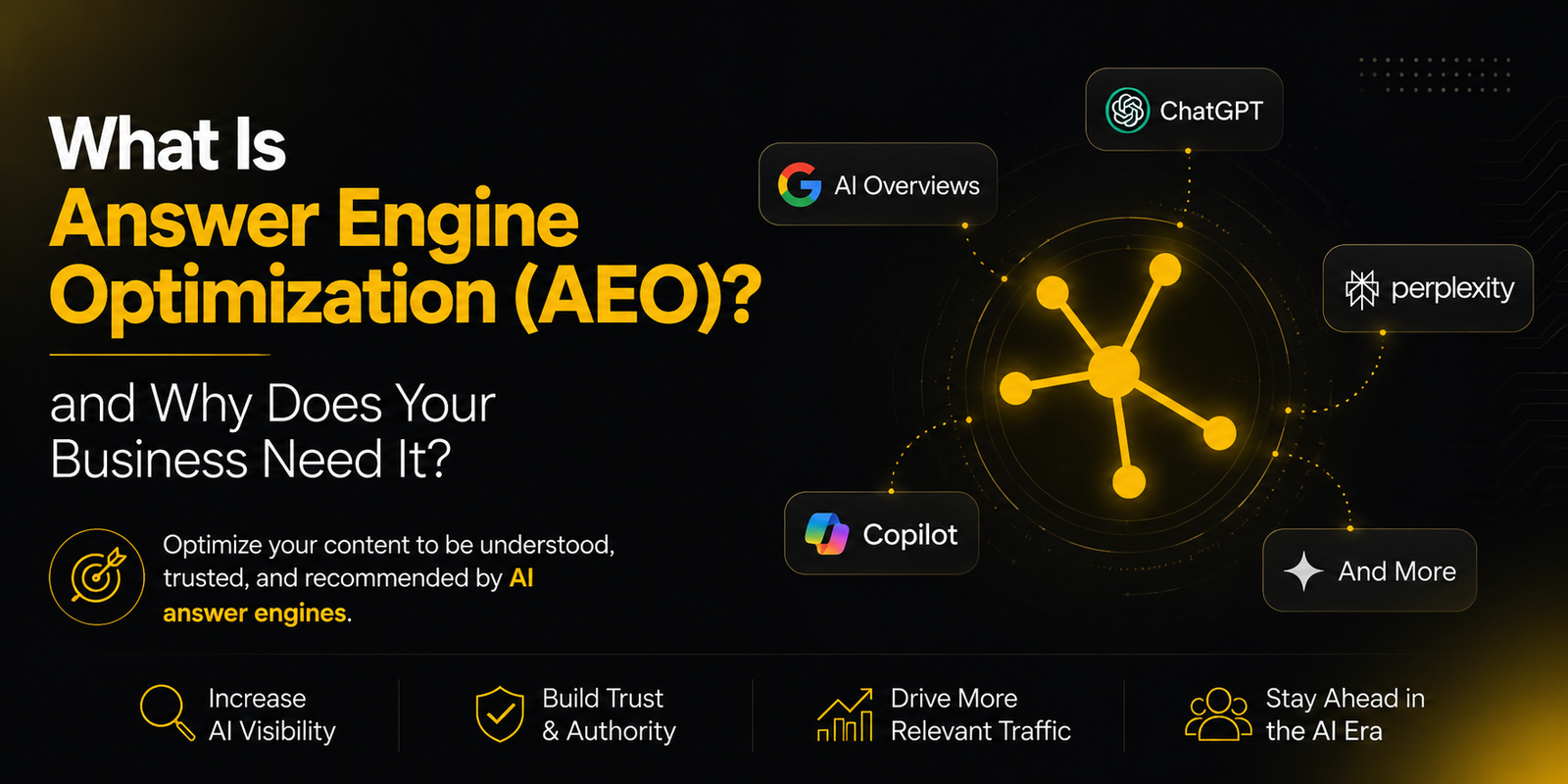
What Is Answer Engine Optimization (AEO) and Why Does Your Business Need It?
Introduction
A growing number of people no longer start their research with a traditional search engine. Instead, they ask a question directly to an AI powered platform, such as ChatGPT, Google’s AI Overviews, or Perplexity, and expect a clear, direct answer.
These platforms are often called answer engines, because their goal isn’t to return ten blue links. Their goal is to generate a single, synthesized answer, sometimes pulling from multiple sources at once, and sometimes recommending specific brands, products, or services along the way.
This shift matters for one simple reason: if your business isn’t structured in a way that AI systems can understand and reference, you may be invisible in these answers, even if you rank well in traditional search results.
That’s where Answer Engine Optimization (AEO) comes in. Ranking on a traditional search results page is no longer the finish line. It’s one part of a much bigger visibility picture, and businesses that only optimize for classic SEO risk missing a growing share of how customers actually discover them.
This article explains what AEO is, how it differs from traditional SEO, why AI visibility is becoming a business priority, and how to start building an AEO strategy.
What Is Answer Engine Optimization (AEO)?
Answer Engine Optimization (AEO) is the practice of structuring and optimizing content so that AI systems and answer engines can easily understand, evaluate, and potentially reference it when generating answers to user questions.
In simpler terms, AEO helps your business become a source that AI platforms can confidently pull from, cite, or mention when someone asks a question related to your industry, products, or services.
An “answer engine” is any platform that generates a direct response to a user’s question rather than simply listing links. Examples include:
- Google AI Overviews
- ChatGPT
- Perplexity
- Other AI powered chat and search assistants
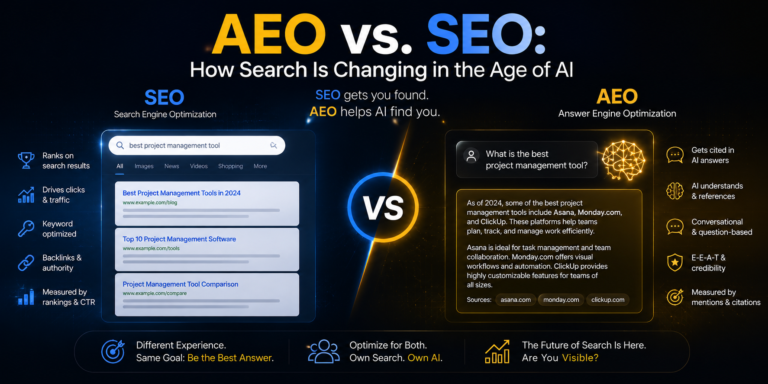
While traditional SEO focuses on ranking web pages in a list of search results, AEO focuses on making content easy for AI systems to interpret, extract, and use as the basis for a generated answer. This typically means writing in a clear, direct, well organized way; clearly defining key terms and concepts; and backing claims with credible, verifiable information.
AEO is not a replacement for SEO. It’s better understood as an extension of good SEO and content practices, adapted for how AI systems read and synthesize information.
How Search Is Changing in the Age of AI
Search behavior has evolved significantly over the past decade, and AI is accelerating that change. Understanding this progression helps explain why AEO has become relevant.
Traditional keyword based search. For years, search engines matched user queries to web pages primarily based on keywords, links, and page relevance. Users typed a query, scanned a list of results, and clicked through to find their answer.
Featured snippets and zero click searches. Search engines began surfacing direct answers at the top of results pages, often pulled from a single source. This introduced the concept of “zero click” searches, where users got their answer without visiting a website.
Conversational search. Voice assistants and chat based interfaces made it normal to ask questions in natural, conversational language rather than short keyword phrases, such as “What’s the best CRM for a small consulting firm?” instead of “best CRM small business.”
AI generated answers. Platforms like Google AI Overviews and ChatGPT now generate original, synthesized responses to user questions. Instead of directing users to a webpage, the platform itself becomes the answer, often with source citations included.
Multi source AI responses. Many AI systems pull from and reference multiple sources within a single answer, comparing options, summarizing perspectives, or recommending several businesses at once.
Each of these shifts moves the user experience further away from “click and read” and closer to “ask and receive an answer.” For businesses, that means visibility increasingly depends on being one of the sources an AI system chooses to draw from, not just ranking on a results page.
AEO vs. Traditional SEO: What’s the Difference?
AEO and SEO share the same foundation: high quality, relevant, well structured content. But they are optimized for different outcomes.
| Factor | Traditional SEO | Answer Engine Optimization (AEO) |
|---|---|---|
| Primary goal | Rank web pages highly in search results | Be understood, referenced, or cited in AI generated answers |
| How users search | Keyword based queries | Natural, conversational questions |
| Content format | Optimized pages, meta tags, backlinks | Direct, self contained answers with clear structure |
| Search experience | List of ranked links | Synthesized answer, sometimes with citations |
| Visibility measurement | Rankings, organic traffic, click through rate | Brand mentions, citations, and appearances in AI answers |
| Role of authority and trust | Backlinks and domain authority | Demonstrated expertise plus consistent, verifiable information across the web |
| Content structure | Keyword optimized headings and copy | Clear definitions, direct answers, and logically structured information |
The key takeaway: AEO does not replace SEO. Strong technical SEO, quality backlinks, and site performance still matter, partly because AI systems often rely on well indexed, well structured websites as source material. AEO adds a layer on top of SEO, focused specifically on how content is interpreted and used by AI systems.
Why AI Visibility Matters for Your Business
AI visibility refers to how, where, and how accurately your business appears within AI generated answers, recommendations, and summaries.
As more people rely on AI platforms for research, brand visibility increasingly depends on whether AI systems mention, cite, or recommend your business when relevant questions are asked. A few reasons this matters:
- Brand mentions and citations in AI answers can influence buying decisions before a customer ever visits your website.
- Recommendations generated by AI tools may shape which businesses a prospective customer considers first.
- Inaccurate or missing information about your business in AI generated answers can be just as damaging as poor search rankings, because customers may not investigate further.
- Early stage research for many buyers now starts with an AI conversation rather than a search engine, meaning businesses that aren’t visible at this stage may never make it into later consideration.
Monitoring AI visibility, understanding how your brand is represented, and identifying gaps or inaccuracies is becoming as important as monitoring traditional search rankings.
How Does AEO Work?
An effective AEO strategy is built on several interconnected elements. None of these work in isolation, they reinforce one another.
Creating clear, direct answers to real user questions. Content should directly and concisely answer the specific questions your audience is asking, rather than burying the answer in lengthy, indirect copy.
Building topical authority. Covering a topic thoroughly, across multiple related questions and subtopics, helps demonstrate depth of knowledge, which AI systems can use as a signal of reliability.
Demonstrating expertise and trust. This includes clear authorship, credentials, accurate information, and content that reflects real, verifiable experience, often described using the principles of experience, expertise, authoritativeness, and trust (E-E-A-T).
Structuring content for easy interpretation. Using clear headings, short paragraphs, bullet points, and logical organization makes it easier for both readers and AI systems to extract meaning.
Using relevant schema markup where appropriate. Structured data (such as FAQ, Article, or Organization schema) helps search engines and AI systems better understand the context and structure of your content.
Improving website content quality. Outdated, thin, or vague content is less likely to be referenced by AI systems than accurate, well maintained, and genuinely useful content.
Strengthening brand authority and online mentions. Consistent, accurate information about your business across your website, directories, review platforms, and other reputable sources helps reinforce credibility.
Monitoring AI visibility and brand representation. Regularly checking how your business appears (or doesn’t appear) in AI generated answers helps identify opportunities and correct inaccuracies.
What Are the Benefits of AEO?
Investing in AEO can support several business outcomes over time:
- Increased visibility in AI powered search, as more of your content becomes structured in a way answer engines can understand and use.
- Greater brand awareness, particularly when your business is mentioned or cited within AI generated responses.
- More opportunities to be mentioned or cited across a growing range of AI platforms and conversational search tools.
- Reaching customers earlier in the buying journey, since many buyers now begin their research with an AI conversation rather than a search engine.
- Supporting traditional organic search performance, since many AEO best practices, such as clear structure and strong content quality, also benefit conventional SEO.
- Building long term digital authority, as consistent, high quality, well structured content compounds in value over time.
It’s important to set realistic expectations. AEO can improve the likelihood of appearing in AI generated answers, but no strategy can guarantee specific citations, rankings, or visibility outcomes, since AI systems determine sourcing dynamically and their methods continue to evolve.
Who Needs Answer Engine Optimization?
AEO is relevant to a wide range of businesses, particularly those that rely on being found, trusted, and chosen by customers who are actively researching solutions. This includes:
- B2B companies, where buyers often research extensively and compare options before ever contacting sales.
- SaaS companies, especially in competitive categories where AI tools are frequently used to compare features and providers.
- Professional services firms (legal, financial, consulting, and similar industries) where trust and expertise are major decision factors.
- Local businesses, which can benefit from accurate, consistent information appearing in local and conversational AI queries.
- Ecommerce brands, particularly for product comparisons, recommendations, and buying guides generated by AI tools.
- Businesses in competitive markets, where being one of the sources an AI system references can be a meaningful differentiator.
In short, if your customers use search engines, chatbots, or AI assistants at any stage of their research or buying process, AEO is relevant to your business.
How to Start an AEO Strategy
Businesses can begin building an AEO strategy with a structured, step by step approach:
- Audit current search and AI visibility. Understand how your business currently appears (or doesn’t appear) in both traditional search results and AI generated answers.
- Identify important customer questions. Map out the specific questions your target audience asks at each stage of their research and buying journey.
- Analyze competitors and industry topics. Review how competitors are represented in AI answers and identify content gaps or opportunities.
- Create helpful, authoritative content. Develop content that directly, clearly, and accurately answers real customer questions.
- Optimize existing pages. Improve structure, clarity, and depth on your most important existing pages rather than only creating new content.
- Strengthen technical SEO and structured data. Ensure your site is crawlable, fast, well organized, and uses appropriate schema markup.
- Monitor AI visibility over time. Continue tracking how your brand appears in AI generated answers, and adjust your strategy as platforms and behaviors evolve.
This is an ongoing process rather than a one time project, since AI platforms, algorithms, and user behavior continue to change.
Why AEO Should Be Part of Your Digital Strategy
AEO shouldn’t be viewed as a replacement for SEO, content strategy, or traditional digital marketing. Instead, it works best as a complementary layer within a broader digital visibility strategy.
Strong technical SEO provides the foundation AI systems rely on to crawl and understand your site. Quality content strategy ensures your material is genuinely useful and answers real questions. AI visibility efforts help ensure that strong foundation actually translates into presence within AI generated answers.
Businesses that treat SEO, content, and AEO as connected parts of one strategy, rather than separate, competing initiatives, are best positioned to maintain visibility as search continues to evolve.
Get Your Free AI Visibility Scorecard
Want to know how your business currently shows up in AI generated answers? Get your Free AI Visibility Scorecard and see where your brand stands today, and where the opportunities are to improve your visibility across AI search and answer engines.
Frequently Asked Questions About AEO
What does AEO stand for?
AEO stands for Answer Engine Optimization, the practice of optimizing content so AI systems and answer engines can understand, evaluate, and potentially reference it when generating answers.
What is the difference between SEO and AEO?
SEO focuses on ranking web pages in traditional search results, while AEO focuses on structuring content so it can be understood and referenced by AI systems that generate direct answers. They share the same foundation of quality, relevant content but serve different visibility goals.
Does AEO replace SEO?
No. AEO works alongside SEO rather than replacing it. Strong technical SEO and content quality remain essential, since AI systems often rely on well structured, well indexed websites as source material.
How does AEO improve AI visibility?
AEO improves AI visibility by making content clearer, better structured, and more directly aligned with the specific questions users ask, which can increase the likelihood that AI systems reference or cite it.
How long does AEO take to show results?
Timelines vary depending on your industry, competition, and current content quality. AEO is an ongoing effort, and improvements in AI visibility typically develop gradually rather than immediately.
What are AEO services?
Answer engine optimization services typically include AI visibility audits, content strategy and creation, technical SEO improvements, structured data implementation, and ongoing monitoring of how a business appears in AI generated answers.
Can small businesses benefit from AEO?
Yes. Small businesses, including local and service based businesses, can benefit from AEO by ensuring their information is clear, accurate, and consistently represented across the platforms AI systems draw from.