
AEO Pipeline Velocity: How AI Recommendations Shorten Sales Cycles
Quick Overview:
AEO pipeline velocity measures how efficiently AI search recommendations convert prospective buyers into closed business compared to traditional multi-touch outbound sales. When an answer engine cites your company directly in response to high-intent prompts, the traditional six-month B2B evaluation collapses into an immediate commercial engagement. Building machine-readable authority establishes your brand as the primary recommendation for AI assistants, generating pre-sold enterprise demand and predictable commercial momentum.
The Collapse of the Traditional B2B Sales Funnel
For decades, enterprise pipeline velocity followed a predictable, labor-intensive formula. A prospect downloaded a whitepaper, entered an automated email nurture sequence, booked an introductory call with a sales representative, and sat through multiple demonstration rounds before sending an RFP. This traditional process required months of nurturing and substantial team overhead to advance a single deal across pipeline stages.
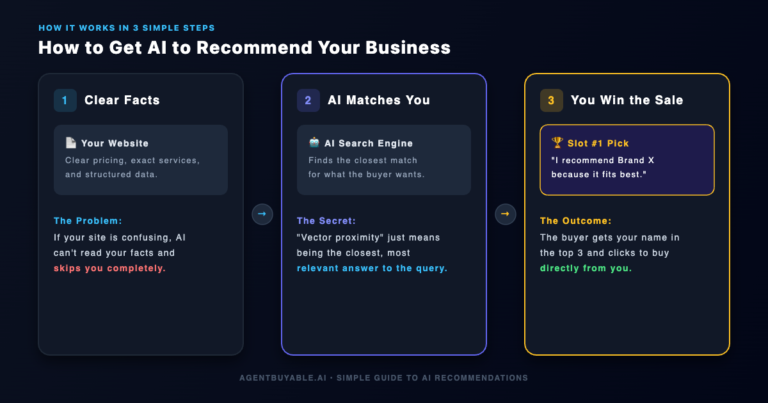
Today, decision-makers conduct high-stakes vendor evaluations inside conversational AI platforms. The traditional sales funnel is collapsing into a single moment: the prompt. A buyer no longer searches, compares, and narrows a list over several weeks. They ask an AI assistant, and whoever gets named in that answer just won the first and most important step of the sale. This shift is what we call Prompt-to-Sale.
When an executive asks Claude or ChatGPT for the top solution to solve an infrastructure bottleneck, the engine synthesizes verified data points and presents one to three vetted providers. There is no browsing through search pages or reading gated eBooks. The engine delivers a definitive recommendation, creating unprecedented AEO pipeline velocity for the named enterprise.
“AEO is client acquisition in its purest form. When AI recommends you by name to a buyer who has never heard of you, that is a customer you did not have to chase.”
Why AEO Pipeline Velocity Delivers Pre-Sold Buyers
Traditional inbound leads arrive with questions and skepticism. They discovered your brand through a paid ad or generic search snippet, meaning your sales team must spend weeks establishing credibility, validating capabilities, and defending price points. Conversely, buyers generated through answer engine optimization arrive with high purchase conviction.
Answer engines act as impartial advisors in the buyer’s perception. When an AI system analyzes market capabilities and returns your service as the best match, the endorsement carries institutional authority. The prospect enters the sales conversation with pre-established trust, seeking confirmation of implementation details rather than basic validation of your core competency.
This dynamic accelerates every downstream stage of your pipeline:
- Eliminated Qualification Cycles: AI assistants pre-qualify vendors against the exact parameters of the prompt before returning a recommendation.
- Shortened Proposal Reviews: Buyers arrive with clear expectations around your architecture, deliverables, and service boundaries.
- Reduced Price Sensitivity: Authoritative recommendations position your firm as the definitive category solution rather than a fungible bidding option. Explore our structured framework on the AEO services page.
Comparison: Traditional Pipeline vs. AEO Pipeline Velocity
The structural difference between manual pipeline generation and AI-driven client acquisition becomes clear when comparing operational milestones:
| Pipeline Dimension | Traditional Inbound & Outbound | AEO Pipeline Velocity |
|---|---|---|
| Discovery Mechanism | Cold outreach, ads, keyword rankings | Verified AI assistant citation & recommendation |
| Buyer Intent State | Passive research, browsing solutions | Active problem solving with immediate budget |
| Initial Trust Level | Low, vendor must prove claims manually | High, validated by third-party AI synthesis |
| Conversion Outcome | Multi-step form fill, discovery call scheduling | Zero-friction close / direct-to-sale transaction |
| Average Deal Cycle | 90 to 180 days across enterprise tiers | 14 to 30 days from initial prompt citation |
| Operational Freedom | High executive drag and constant deal chasing | Autonomous pipeline momentum with minimal friction |
The Agentic Commerce Layer: Closing the Adoption Gap
Achieving superior pipeline velocity requires more than informational visibility. As autonomous agents take on procurement tasks, they evaluate whether a vendor is technically recommendable and operationally transactable.
Protocols like the Agentic Commerce Protocol (ACP) and Universal Commerce Protocol (UCP) provide the transactional rails for AI agents to initiate service agreements, verify SLA compliance, and execute payments directly. The technology is fully operational today. The primary barrier facing enterprises is an adoption gap, not a readiness gap. Companies that align their data structures now capture compound advantages before their competitors recognize the shift.
Review our transparent AEO deployment pricing to understand how structured data implementation transforms your digital footprint into an automated transaction engine.
How to Build Machine-Readable Authority for Your Firm
Answer engines do not crawl websites the way traditional indexers do. They extract semantic entities, cross-reference knowledge graphs, and calculate probabilistic confidence scores. To maximize your AEO pipeline velocity, your digital presence must satisfy three core engineering standards:
1. Implement Explicit Knowledge Graph Triples
Ensure that your entity attributes, service definitions, pricing structures, and industry recognitions are declared through nested JSON-LD schema. Ambiguous marketing copy forces answer engines to guess, while structured semantic triples allow models to cite your capabilities with absolute factual certainty.
2. Publish Definitive Solution Matrices
Structure your published content around specific operational bottlenecks, deployment timelines, and integration parameters. When an AI crawler parses your documentation, clear data points allow it to confidently match your service to specific buyer requirements during live reasoning queries.
3. Align Verification Citations Across the Web
Answer engines validate primary web properties against authoritative third-party repositories. Consistent entity identifiers, public case studies, and industry citations create the corroboration network large language models require before placing a brand in the top recommendation slot.
Accelerate Your Commercial Pipeline
Discover how your company currently appears in generative search engines and learn how structured AEO positions your brand for dominant pipeline velocity. Explore our strategic insights across the AgentBuyable AEO blog.