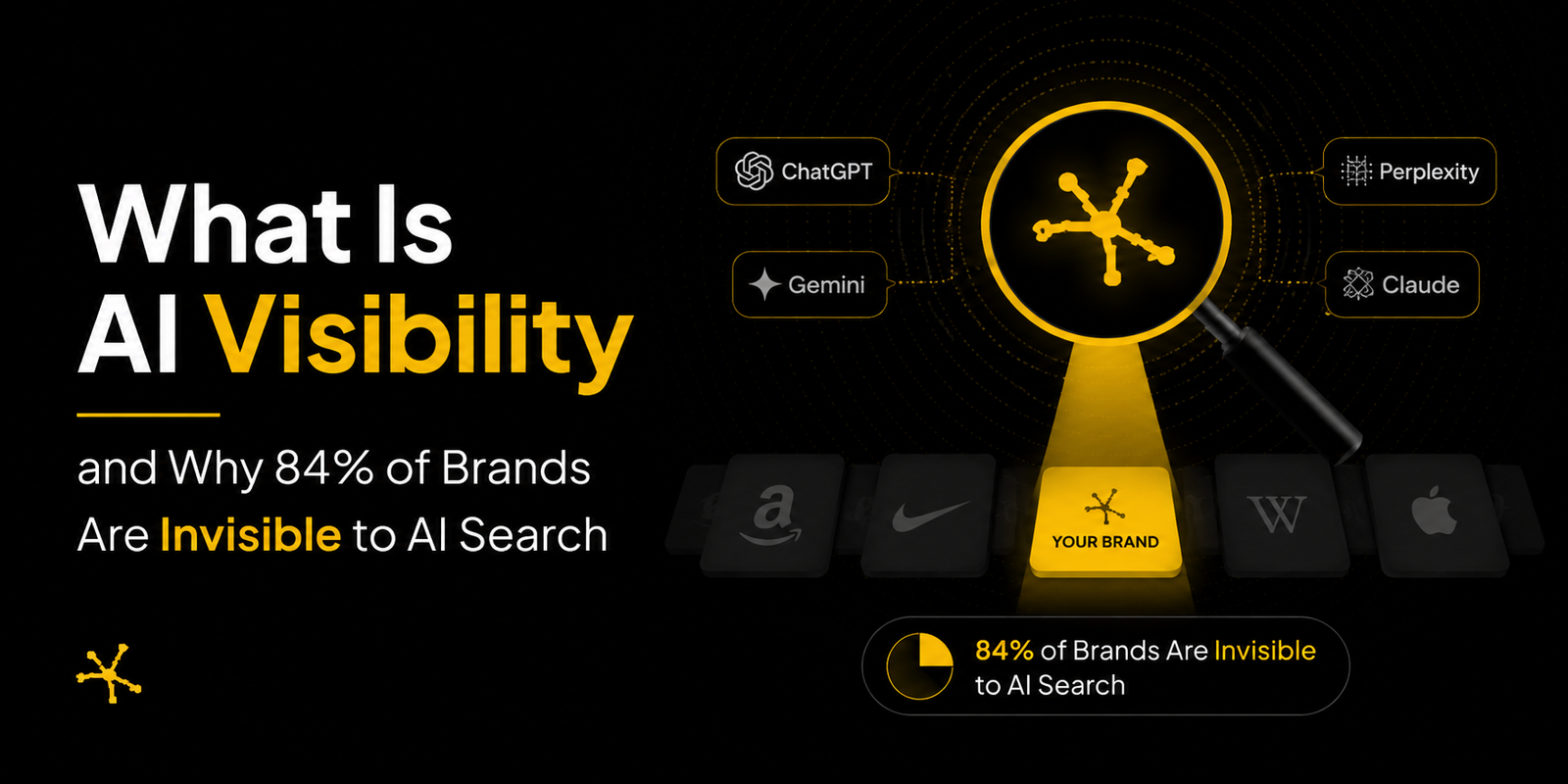
What Is AI Visibility and Why 84% of Brands Are Invisible to AI Search
According to research from Ahrefs, roughly 28% of the web pages that ChatGPT cites most frequently have little or no presence in Google’s organic search results. Some of these pages generate zero traditional search traffic at all, yet they show up again and again inside AI-generated answers. Google rankings and AI recommendations, it turns out, are no longer measuring the same thing.
For the past two decades, marketing teams have judged search performance almost entirely through one lens: rankings, organic traffic, and click-through rate. That lens still matters. But a growing body of independent research from Ahrefs, Gartner, SparkToro, and others shows that a second, largely invisible battle for attention is happening inside ChatGPT, Gemini, Claude, Copilot, and Perplexity. A business can hold the #1 spot on Google for its most important keyword and still never get mentioned when a prospective customer asks an AI assistant for a recommendation.
That gap has a name now: AI Visibility the degree to which AI systems recognize, trust, cite, and recommend a business when someone asks a relevant question.
So here’s the question every marketing leader, founder, and growth team should be asking right now: is your brand visible where your customers are increasingly asking their questions? For a growing share of buyers, the answer decides whether you’re ever considered at all. This article breaks down what AI Visibility actually means, why it’s becoming the next core marketing KPI, and what a business can concretely do to improve it.
What Is AI Visibility?
AI Visibility is the measurable degree to which large language models and AI-powered search tools recognize a brand as a real, trustworthy entity and choose to mention, cite, or recommend it in response to relevant user questions.
It is not a single metric. It’s a composite of several signals working together:
- Brand mentions how often an AI system names your company in a response, even without a link
- Entity recognition whether the AI understands who you are, what you do, and how you relate to your category
- Citation frequency how often your content is used as a cited source
- AI recommendation rate how often you’re suggested as a solution to a relevant problem
- Knowledge graph presence whether structured data sources (Wikipedia, Wikidata, Crunchbase, G2, industry directories) describe your business consistently
- Content authority whether your published content is treated as an expert, trustworthy reference
- Structured data schema markup and machine-readable signals that make your content easy to parse
- Digital PR third-party mentions across news, review sites, and industry publications
- Trust signals reviews, testimonials, certifications, and consistent branding across the web
- Semantic relevance how closely your content maps to the actual language people use when prompting AI
- Multi-platform presence visibility across ChatGPT, Gemini, Perplexity, Copilot, and Claude, since each pulls from different sources and behaves differently
AI Visibility measures something rankings never captured: whether a machine believes your business is a credible answer to a real question not merely whether your page ranks for a keyword.
Why AI Visibility Matters More Than Traditional Rankings
Gartner has projected that traditional search engine volume will decline by roughly 25% by 2026 as consumers shift toward conversational AI tools for the kinds of questions that used to start with a Google search. That’s not a marginal shift it’s a redirection of a meaningful share of buyer research behavior away from the ten blue links and into a single AI-generated answer.
When a prospective customer asks ChatGPT “what’s the best AI visibility platform for a B2B SaaS company” or “which agency should I hire for GEO,” the AI doesn’t return ten links to compare. It returns a short, synthesized answer naming a handful of brands sometimes just two or three. If your business isn’t one of them, you don’t just rank lower. You don’t exist in that conversation at all.
This is the structural reason AI Visibility deserves board-level attention: the competitive slots are shrinking, and the criteria for winning them are different from classic SEO ranking factors.
How AI Search Engines Decide Which Brands to Mention
AI systems don’t rank pages the way Google does. Instead, they retrieve information from multiple sources search indexes, their own web crawls, and licensed data then synthesize an answer built around whichever sources seem most trustworthy, current, and directly relevant to the question asked.
Research analyzing over a million ChatGPT citations found the platform evaluates retrieved pages using signals like title, URL structure, and snippet quality before deciding what to open and cite, and it only ends up citing roughly half of what it retrieves. Site-level authority strongly predicts whether a domain gets cited at all, but page-level link equity the metric most SEO teams obsess over matters far less than expected.
Other research-backed patterns are worth noting:
- Sites with a much larger base of referring domains are considerably more likely to be cited by ChatGPT than smaller, less-linked sites, according to SE Ranking’s analysis.
- Domains with an active presence on Reddit and Quora are cited notably more often, even though ChatGPT rarely credits Reddit directly as a source.
- A presence on review platforms like G2, Capterra, and Trustpilot meaningfully increases the odds of being selected as a source, per the same SE Ranking research.
- Page load speed correlates with citation likelihood fast-loading pages are cited several times more often than slow ones.
In short: AI systems reward entities that are corroborated across many independent parts of the internet not just the ones with the most backlinks pointing at one page.
Google Rankings vs AI Visibility
It helps to think of Google rankings and AI Visibility as two overlapping but distinct systems, each with its own logic.
Ahrefs’ research on ChatGPT citation behavior found that only around 12% of the links AI assistants cite also appear in Google’s top 10 for the same query, and that roughly 80% of AI-cited pages don’t rank anywhere in Google’s top 100 results for that query. Perplexity is the exception its citations track Google’s rankings far more closely than ChatGPT’s or Gemini’s do, since it favors pages already validated by traditional search signals.
Traditional SEO Metrics vs AI Visibility Metrics
| Traditional SEO Metric | What It Measures | AI Visibility Metric | What It Measures |
|---|---|---|---|
| Organic Traffic | Clicks from search engines | AI Citation Rate | How often your content is cited in AI answers |
| Keyword Rankings | Position on a SERP | AI Brand Mentions | How often you’re named, cited or not |
| Click-Through Rate | % of viewers who click your listing | Recommendation Frequency | How often AI suggests you as a solution |
| Backlinks | Links pointing to your domain | Entity Authority | How clearly AI understands who you are |
| Domain Authority Score | Composite link-based score | Knowledge Graph Strength | Consistency of structured facts about you |
| Search Volume | Query demand for a keyword | Prompt Coverage | Share of relevant prompts where you appear |
| SERP Position | Rank number 1–10+ | AI Share of Voice | Your mentions vs. competitors’ across AI answers |
The Difference Between SEO Rankings and AI Recommendations
SEO ranking is a competition to be clicked. AI recommendation is a competition to be trusted enough to be cited without a click ever happening.
Google’s ranking algorithm is built around signals that predict user satisfaction after a click: page speed, engagement, backlink profile, and keyword relevance. AI systems, by contrast, are optimizing for something closer to editorial judgment they’re selecting which few sources deserve to be synthesized into a single confident answer. That favors depth, clarity, structure, and corroboration from independent third parties over raw link volume.
This is why a thin, well-optimized landing page can outrank a competitor on Google while never once being mentioned by ChatGPT and why a comparatively obscure blog post can become a go-to AI citation because it answers one specific question with unusual clarity.
Why Many High-Ranking Websites Never Get Mentioned by AI
It’s entirely possible common, even for a business to dominate Google and still be invisible in AI answers. A few consistent explanations show up across the research:
- The page targets a keyword, not a question. AI systems are built to answer conversational, natural-language questions. Content built purely around a head keyword often fails to directly answer the follow-up questions AI assistants actually generate.
- The entity isn’t clearly defined. If AI systems can’t confidently resolve who you are, what category you compete in, and what you’re known for, they won’t risk citing you even if your page ranks well.
- The content lacks third-party corroboration. AI models weigh independent validation heavily. A page that only exists on your own domain, with no outside mentions, reviews, or citations, has far less credibility signal than one echoed across review sites, forums, and press coverage.
- The domain lacks the authority threshold AI models look for. Research from SE Ranking found that domains with tens of thousands of referring domains are considerably more likely to be cited than smaller sites a bar that many capable, high-ranking small businesses simply haven’t cleared yet.
The Biggest Reasons Brands Stay Invisible to AI
Beyond the structural issues above, most AI-invisible brands share a familiar set of content and authority gaps:
- Weak topical authority publishing scattered posts instead of comprehensive coverage of a subject
- Poor entity recognition inconsistent naming, unclear “About” pages, and no structured data describing the business
- Thin content pages that summarize rather than genuinely answer a question in depth
- Lack of expert content no named authors, credentials, or demonstrated first-hand experience
- Missing structured data no schema markup to help machines parse your content
- Inconsistent branding different descriptions of the company across the web that confuse entity matching
- Low-authority mentions being mentioned only on low-trust sites or not at all
- Weak digital PR no earned media, guest features, or third-party validation
- No citations content nobody outside the company references or links to
- Poor semantic relevance content that doesn’t match the phrasing of real user prompts
- Outdated content stale pages that haven’t been refreshed as facts, pricing, or context changed
The Core Components of AI Visibility
Pulling the framework together, AI Visibility rests on eleven interlocking components: brand mentions, entity recognition, citation frequency, AI recommendation rate, knowledge graph presence, content authority, structured data, digital PR, trust signals, semantic relevance, and multi-platform presence. No single tactic fixes AI Visibility. It’s a compounding system entity clarity strengthens knowledge graph presence, which strengthens citation odds, which strengthens brand mention frequency across every AI platform at once.
How to Measure Your AI Visibility
Measuring AI Visibility takes a different workflow than checking a rank tracker. A practical approach combines:
- Manual prompt testing Ask ChatGPT, Gemini, Perplexity, Copilot, and Claude the actual questions your buyers would ask, and log whether, where, and how you’re mentioned.
- Citation tracking tools Platforms like Ahrefs’ Brand Radar and similar AI-monitoring tools now report on which pages get cited by which AI assistants.
- Competitive share-of-voice comparison Run the same prompts for your top competitors to see how often you appear relative to them.
- Knowledge graph audits Check whether Wikidata, Crunchbase, G2, and industry directories describe your business accurately and consistently.
- AI referral traffic in analytics Segment traffic from chatgpt.com, perplexity.ai, and other AI referrers to see what’s already converting.
How to Improve AI Visibility
10 Ways to Increase AI Visibility
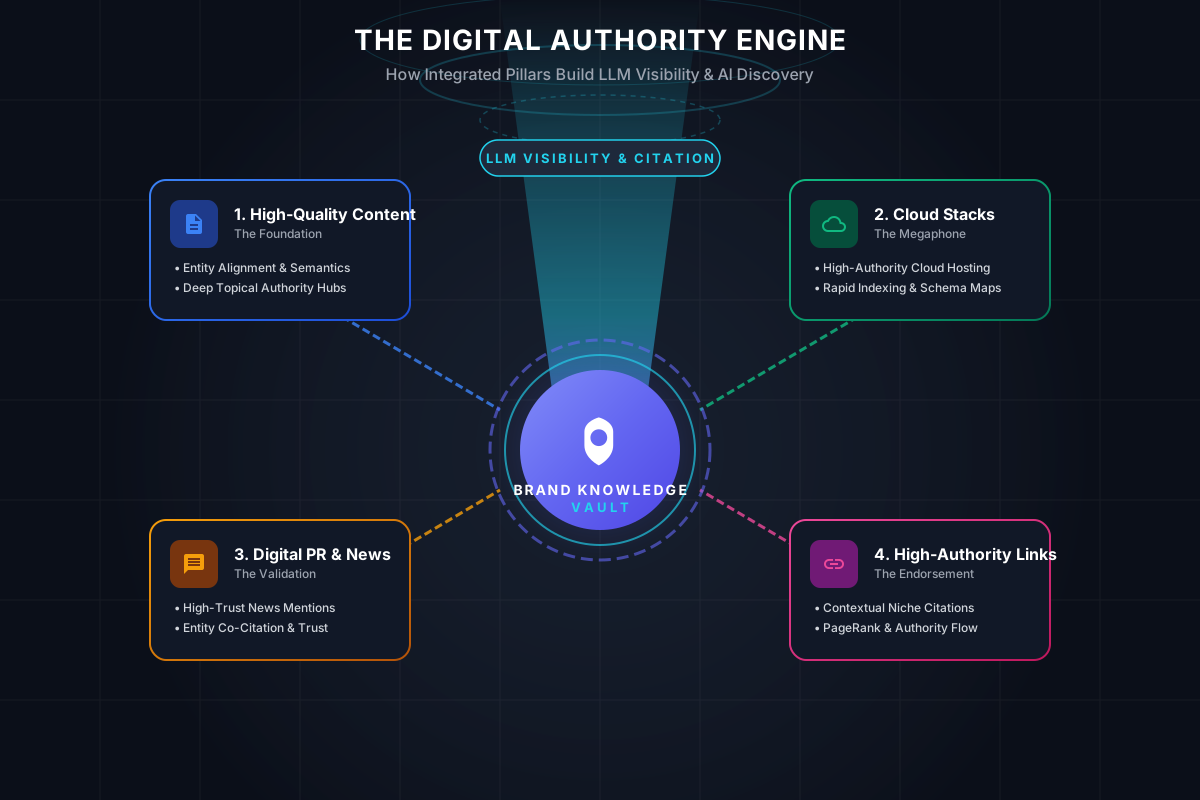
1. Build topical clusters, not isolated posts Why it matters: AI systems reward demonstrated depth across an entire subject, not a single well-ranked page. How to implement: Map every question a buyer might ask about a topic, then build a hub-and-spoke content structure that answers each one thoroughly. Common mistake: Publishing one “ultimate guide” and assuming it covers the whole topic.
2. Invest in entity optimization Why it matters: AI models need to confidently resolve who you are before they’ll cite you. How to implement: Keep your name, description, and category consistent across your site, social profiles, directories, and press mentions. Use schema markup to define your organization explicitly. Common mistake: Letting your company description drift across different platforms and bios.
3. Build genuine FAQ content Why it matters: FAQ-formatted content maps directly onto how people phrase prompts to AI assistants. How to implement: Write FAQs around real questions from sales calls, support tickets, and search queries not invented ones. Common mistake: Generic FAQs that don’t reflect the specific questions your actual buyers ask.
4. Publish original research Why it matters: Original data is exactly the kind of citable, non-duplicable content AI systems are built to surface. How to implement: Survey your customers, analyze your own product data, or run small studies relevant to your niche, then publish the findings clearly. Common mistake: Recycling third-party statistics instead of generating your own.
5. Implement structured data thoroughly Why it matters: Schema markup helps machines parse exactly what your content is and who it’s from. How to implement: Add Organization, Article, FAQ, and Product schema consistently across your site. Common mistake: Adding schema once at launch and never updating it as pages change.
6. Strengthen EEAT signals Why it matters: Experience, Expertise, Authoritativeness, and Trustworthiness are core to whether AI models treat you as a credible source. How to implement: Attribute content to named experts, publish credentials, and show first-hand experience with the subject. Common mistake: Publishing unattributed, generic content with no visible authorship.
7. Keep brand messaging consistent everywhere Why it matters: Inconsistent descriptions across the web make entity recognition harder for AI systems. How to implement: Audit every directory, social bio, and press mention for consistent naming and category description. Common mistake: Treating each platform’s “About” section as a separate, disconnected task.
8. Earn high-authority backlinks Why it matters: Domain-level authority remains one of the strongest predictors of AI citation likelihood. How to implement: Prioritize coverage and links from established, high-trust publications in your industry. Common mistake: Chasing volume of low-quality links instead of a smaller number of credible ones.
9. Run real digital PR Why it matters: Third-party mentions on outlets AI models already trust compound your citation odds far more than owned content alone. How to implement: Pitch data, expert commentary, and original research to journalists and industry publications. Common mistake: Treating PR as a one-off announcement instead of an ongoing distribution strategy.
10. Format content for AI extraction Why it matters: AI systems extract discrete chunks of content, not entire narratives content needs to work as standalone, quotable answers. How to implement: Use clear headers, direct topic sentences, comparison tables, and concise summary boxes that answer one question each. Common mistake: Burying the direct answer under several paragraphs of preamble.
The Metrics Every Marketing Team Should Track
- AI Citation Frequency how often your content is used as a cited source across AI platforms
- AI Recommendation Rate how often your brand is suggested as a solution to a relevant prompt
- Prompt Coverage the share of relevant buyer prompts where you appear at all
- Share of AI Voice your mention frequency relative to named competitors
- Entity Strength how clearly and consistently AI systems can describe who you are
- Brand Mention Rate mentions with or without a citation link attached
- AI Referral Traffic visits arriving from AI platforms, tracked in analytics
- AI-Assisted Conversions how AI-referred visitors convert compared to other channels
These metrics matter because the underlying behavior they track people asking AI assistants instead of typing into a search bar is only growing. Early data suggests AI-referred visitors often convert at meaningfully different rates than traditional organic traffic, which is exactly why these numbers deserve a permanent place next to organic traffic and rankings on the marketing dashboard, not a footnote below them.
Common Mistakes That Hurt AI Visibility
- Treating AI Visibility as identical to SEO and applying no new strategy
- Ignoring off-site signals like reviews, forums, and directories
- Publishing content with no named author or credentials
- Letting brand descriptions drift across different platforms
- Failing to update evergreen content as facts change
- Assuming a #1 Google ranking guarantees AI citation
- Measuring success with organic traffic alone, missing AI referral and citation data entirely
The Future of AI Visibility
The direction of travel is clear even if the exact pace isn’t: buyers are increasingly comfortable asking an AI assistant for a recommendation instead of comparing search results themselves. As that behavior scales, AI Visibility will stop being an experimental add-on and start functioning as a core layer of brand marketing sitting alongside SEO, paid media, and PR rather than beneath them.
Two additional forces are accelerating this shift. First, agentic commerce AI agents that don’t just recommend a product but actually complete a purchase or transaction on a user’s behalf is emerging through frameworks like the Agentic Commerce Protocol (ACP) and Universal Commerce Protocol (UCP). Businesses that aren’t structured to be discoverable and transactable by these agents risk losing not just visibility, but revenue. Second, as more AI platforms compete for user trust, the brands that established multi-platform authority early will have a durable advantage, since entity recognition compounds over time rather than resetting with each algorithm update.
How AgentBuyable Helps Businesses Become AI Visible
AgentBuyable was built around a simple premise: the businesses that win the next decade of discovery will be the ones AI systems already trust to recommend. That requires a different set of services than classic SEO, even though the two disciplines share a foundation.
AgentBuyable’s AI Visibility Audits give a business a clear, evidence-based picture of where it currently stands testing real prompts across ChatGPT, Gemini, Perplexity, Copilot, and Claude to see whether, where, and how a brand shows up today.
From there, AgentBuyable’s AI Search Optimization, AEO Services, and GEO Services address the content, structure, and semantic gaps that keep otherwise strong brands invisible building the topical depth, FAQ coverage, and extractable formatting that AI systems are built to reward.
AI Brand Visibility Services and entity optimization work address the trust layer: ensuring a brand’s identity is described consistently everywhere AI systems look, and that knowledge graph sources like Wikidata, Crunchbase, and industry directories reflect the same accurate story.
Finally, as AI agents move from recommending products to completing transactions on a user’s behalf, AgentBuyable’s ACP/UCP integration and AI Commerce Optimization services help businesses become not just visible, but transactable ready for the agentic commerce layer that’s emerging on top of AI search.
The goal throughout is educational as much as technical: helping teams understand exactly why they’re invisible before prescribing the fix.
See Where Your Brand Shows Up in AI Answers
Most businesses have no idea whether ChatGPT recommends them, whether Gemini recognizes their business, or whether Perplexity ever cites their content. AgentBuyable’s AI Visibility Audit answers all three along with a clear AI Visibility Score and a breakdown of the missed opportunities costing a brand mentions across the leading AI search platforms.
If your team has never tested this, it’s worth finding out before a competitor does. Request your personalized AI Visibility Audit and see exactly where you stand.
Frequently Asked Questions
What is AI Visibility?
AI Visibility is the measurable degree to which AI systems like ChatGPT, Gemini, Perplexity, Copilot, and Claude recognize a brand as a credible entity and choose to mention, cite, or recommend it in response to relevant questions.
How do AI search engines decide which brands to recommend?
They evaluate retrieved content using signals like domain authority, entity clarity, third-party corroboration, content structure, and freshness then synthesize an answer from the sources they trust most, rather than simply listing the top-ranked pages.
Can a business have high Google rankings but low AI Visibility?
Yes. Research shows only a small share of the pages AI assistants cite also rank in Google’s top 10 for the same query, meaning strong Google rankings don’t guarantee any presence in AI-generated answers.
How do you measure AI Visibility?
Through a mix of manual prompt testing across major AI platforms, citation-tracking tools, competitive share-of-voice comparisons, knowledge graph audits, and AI referral traffic segmentation in analytics.
Why is AI Visibility becoming a new KPI?
Because a growing share of buyer research is shifting from typed search queries to conversational AI answers, and traditional SEO metrics don’t capture whether a brand appears in those answers at all.
What are AI brand visibility services?
Services focused on strengthening how consistently and credibly AI systems describe a business including entity optimization, knowledge graph corrections, and third-party trust signal building.
What are AI search visibility services?
Services focused on optimizing content and technical structure so it’s more likely to be retrieved, extracted, and cited by AI search tools often called AEO or GEO work.
How can B2B companies improve AI Visibility?
By building genuine topical depth, publishing original research, strengthening entity consistency, earning high-authority third-party mentions, and formatting content so AI systems can easily extract direct answers.