
The Digital Authority Engine: Why Isolated SEO Tactics Fail in the Age of LLMs and AEO
By Mark Pearson, AI Transformation Partner
The traditional playbook for search engine optimization (SEO) is broken.
For years, businesses treated SEO like a checklist of isolated tasks: write a blog post on Tuesday, buy a handful of backlinks on Thursday, distribute a press release when there is “news,” and hope for the best. In the era of traditional search—where Google simply pointed users to a list of ten blue links—this fragmented approach could occasionally yield results.
But we no longer live in that world.
Today, we are in the midst of a massive paradigm shift driven by Large Language Models (LLMs) like ChatGPT, Claude, Gemini, and Google’s AI Overviews. Search has evolved into Answer Engine Optimization (AEO). Users are no longer just looking for lists of websites; they are looking for direct, synthesized answers.
In this new landscape, AI engines do not just rank pages—they synthesize facts about entities (people, brands, products, and concepts). If your brand is not recognized as a trusted entity with a verified, highly cited digital footprint, you do not exist to the AI.
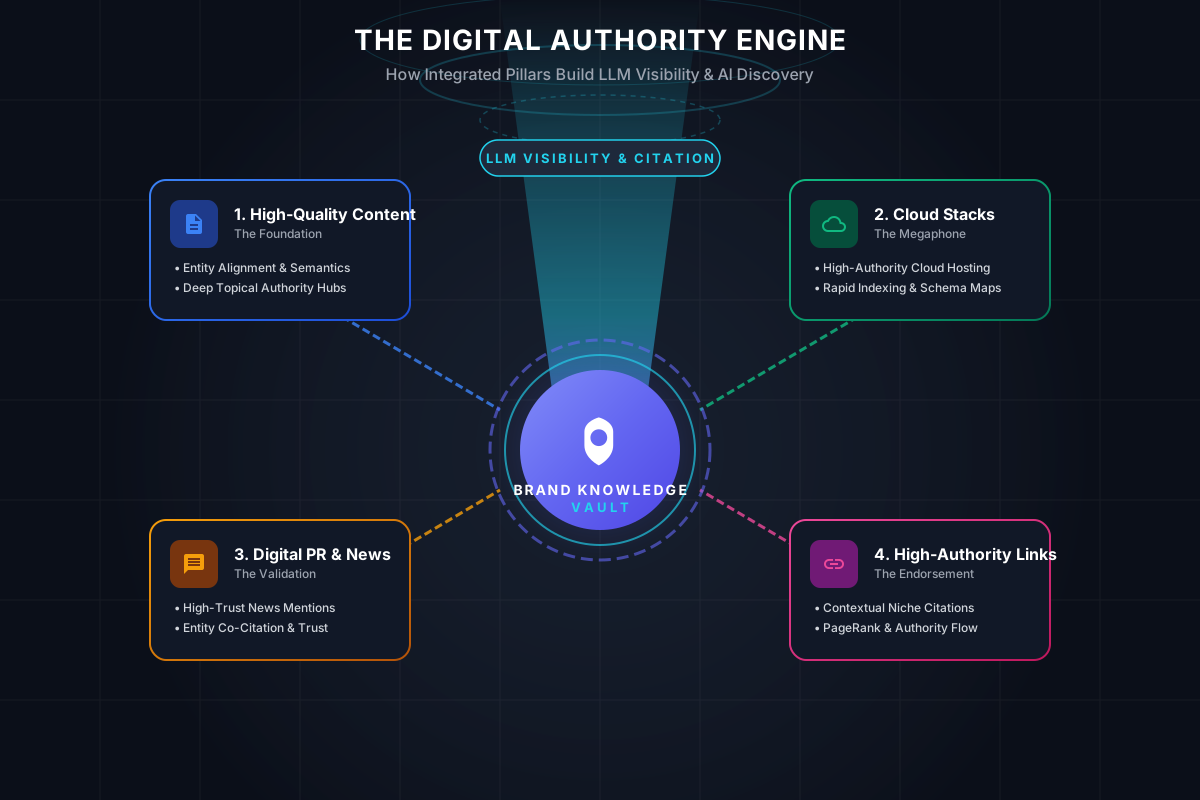
To win today, you must stop thinking in terms of isolated SEO tactics and start building a Digital Authority Engine. This engine is designed to construct a cohesive Brand Knowledge Vault that maximizes your LLM Visibility and forces AI engines to cite your brand as the definitive answer.
Here is how the four core pillars of digital marketing—Content, Digital PR, Cloud Stacks, and Backlinks—work together synergistically to build that authority.
The Core Concept: The Brand Knowledge Vault
Before looking at the tactics, we must understand how AI engines retrieve information.
LLMs do not browse the web the way humans do. They crawl the internet to build a semantic understanding of the world, mapping out relationships between different entities.
Your Brand Knowledge Vault is the collective, verified digital footprint of your business across the web. It is the structured repository of facts, expertise, and associations that AI engines use to understand:
- Who you are (your entity definition).
- What you know (your topical authority).
- Who trusts you (your external validation).
If your vault is empty, fragmented, or contradictory, AI engines will experience “hallucination risk” or low confidence when analyzing your brand. As a result, they will bypass you and recommend a competitor whose vault is robust and clear.
To build a vault that AI engines trust, you must deploy a unified strategy using four synergistic pillars.
Pillar 1: High-Quality Content (The Foundation of the Vault)
If the Brand Knowledge Vault is a repository of your brand’s expertise, Content is the raw data that populates it.
In the AI era, content cannot be thin, generic, or written solely to target a single keyword. AI engines are highly sophisticated semantic processors; they look for deep, comprehensive coverage of topics.
How Content Feeds the Engine:
- Entity Alignment: Your content must be structured around core entities and concepts, not just keywords. It should clearly define your services, your unique methodologies, and your industry perspectives.
- Topical Authority: To be recommended by an LLM, you must prove you have exhaustive knowledge of your niche. This means creating deep-dive guides, original research, and structured hubs that cover every angle of a topic.
- Structured Data & Schema: Content must be formatted so that AI crawlers can easily parse it. This includes using clear heading hierarchies (H2s, H3s) and implementing advanced schema markup (like
Organization,Product, andFAQschema) to explicitly tell the AI what your content is about.
The Synergy: Without deep, high-quality content, you have nothing for the other pillars to promote, validate, or link to. Content is the starting point of all digital authority.
Pillar 2: Cloud Stacks (The Megaphone for Your Data)
Once you have created high-quality content, you need to ensure that search engines and AI crawlers can find, index, and understand it instantly. This is where Cloud Stacks come in.
Cloud Stacking involves hosting highly structured HTML pages, schema files, and entity maps on major cloud platforms like Amazon Web Services (AWS), Google Cloud Platform (GCP), and Microsoft Azure.
How Cloud Stacks Feed the Engine:
- Unmatched Domain Authority: Cloud platforms have some of the highest domain authority and trust scores on the internet. By hosting your structured brand data on these domains, you leverage their trust.
- Rapid Crawling and Indexing: Search engines and AI crawlers prioritize crawling cloud platforms because they are highly stable and trusted. Your brand’s semantic data is indexed and updated almost immediately.
- Semantic Interlinking: Cloud stacks allow you to build a highly organized, interlinked web of pages that map out your brand’s entities, services, and locations, pointing back to your main website.
The Synergy: Cloud Stacks act as a megaphone for your content. They take the structured data from your website and broadcast it from the most trusted domains on earth, ensuring that AI engines have immediate, uninterrupted access to your Brand Knowledge Vault.
Pillar 3: Digital PR & Press Releases (The Trust & Validation)
You can publish great content and broadcast it via Cloud Stacks, but if no one else is talking about you, AI engines will remain skeptical. AI models are trained to avoid recommending unverified or obscure brands. Digital PR and Press Releases provide the external validation your brand needs.
How Digital PR Feeds the Engine:
- Entity Validation: When your brand is mentioned in high-trust, authoritative news outlets (like AP, Yahoo Finance, or major regional publications), it signals to AI engines that your business is a legitimate, real-world entity.
- Co-Citation and Association: LLMs analyze how words and concepts appear together. When your brand name is consistently mentioned in the same paragraph as your industry’s core keywords and top competitors on major news sites, the AI learns to associate your brand with those topics.
- Feeding the Knowledge Graphs: Major news databases are primary training sources for LLMs. Having a consistent stream of high-quality press releases ensures that your brand’s latest milestones, products, and leadership are hardcoded into the AI’s training data and knowledge graphs.
The Synergy: Digital PR takes the claims you make in your content and validates them through trusted, third-party news sources. It turns your self-proclaimed expertise into verified public record.
Pillar 4: High-Authority Backlinks (The Endorsement & Citation)
If Digital PR is the public validation of your brand, High-Authority Backlinks are the formal endorsements.
In traditional SEO, backlinks passed “link equity” to help you rank higher in search results. In the AI era, backlinks serve an even more critical purpose: they act as the citations that AI engines use to back up their answers.
How Backlinks Feed the Engine:
- The “Citable Source” Framework: When an LLM synthesizes an answer for a user, it must cite its sources to maintain accuracy and trust. It prioritizes citing websites that are heavily endorsed by other authoritative, contextually relevant sites in the same niche.
- Contextual Relevance: A link from a highly relevant industry blog or publication tells the AI exactly what your site is trusted for. The anchor text used in these links reinforces the semantic relationship between your brand and your core services.
- PageRank & Trust Flow: High-authority backlinks pass trust and authority down to your main website, raising the overall credibility of your entire Brand Knowledge Vault.
The Synergy: Backlinks are the final seal of approval. They take your validated brand entity (from Digital PR) and your structured content (from Cloud Stacks) and endorse them, forcing AI engines to cite your website as the definitive source of truth.
The Synergy in Action: The Digital Authority Loop
When you stop treating these tactics as isolated tasks and start running them as a unified Digital Authority Engine, a powerful compounding loop is created:
- Content defines your expertise and populates your Brand Knowledge Vault.
- Cloud Stacks structure and broadcast that content from high-trust domains, making it instantly accessible to AI crawlers.
- Digital PR validates your brand’s claims by generating high-trust news mentions and co-citations.
- Backlinks endorse your content, providing the citations that AI engines require to recommend your brand.
Is Your Brand Visible to AI?
In the AI-driven search landscape, ignorance is not bliss—it is invisibility. If AI engines like ChatGPT, Claude, and Google Gemini are not citing your brand when users ask for solutions in your industry, you are losing market share to competitors who have already built their Brand Knowledge Vaults.
As an AI Transformation Partner, I help businesses audit, build, and optimize their digital authority for the modern era.
Stop guessing how AI engines perceive your brand.
Contact me today to schedule a comprehensive Digital Authority & LLM Visibility Audit. We will analyze your brand’s current AI visibility gaps, map out your entity health, and build a custom Digital Authority Engine to ensure your business is the default answer.
***
To discuss how we can implement this unified Digital Authority Engine for your business, let’s connect.