SEO vs AI Search: Why Traditional SEO Fails in Answer Engines (And What Replaces It)
Bottom Line Up Front (BLUF):
When comparing SEO vs AI search, traditional SEO focuses on getting clicks from a page of blue links, while AI search delivers direct recommendations for 1 to 3 chosen brands. The traditional sales funnel is collapsing into a single moment: the prompt. Companies relying solely on keyword rankings are losing visibility as decision-makers switch to ChatGPT, Claude, and Perplexity for vendor selection. To win clients today, businesses must shift from keyword density to structured Answer Engine Optimization (AEO).
The Breakdown: Why SEO vs AI Search Represents a Permanent Shift
For more than two decades, search engine optimization followed a straightforward formula: find high-volume search queries, write long blog posts packed with keywords, build backlinks, and compete for a spot on Google’s first page. If you reached the top three positions, you enjoyed consistent inbound traffic.
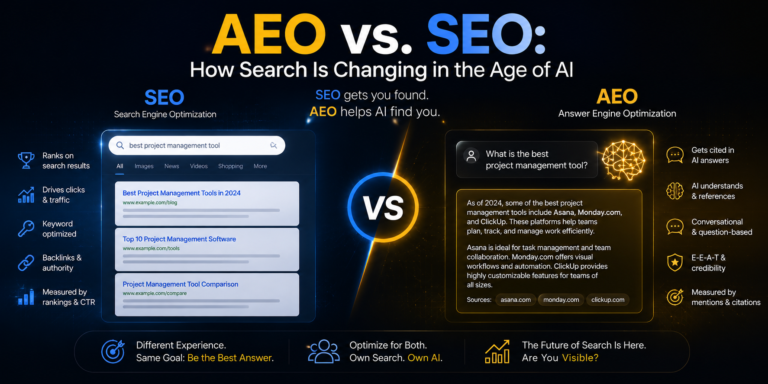
That formula is breaking down rapidly. When evaluating SEO vs AI search, the fundamental difference is how buyers interact with information:
- Traditional Search: The user enters keywords, receives a list of ten links, clicks through several sites, filters out marketing fluff, and tries to compare vendors manually.
- AI Search: The user asks a complex business question and receives a synthesized answer highlighting the 1 to 3 best solutions with immediate reasoning.
The traditional sales funnel is collapsing into a single moment: the prompt. A buyer no longer searches, compares, and narrows a list over weeks. They ask an AI assistant, and whoever gets named in that answer just won the first and most important step of the sale. This shift is what we call Prompt-to-Sale.
In AI search, there is no second page. If your brand is not recommendable to large language models, your business is invisible to modern buyers.
Direct Comparison Matrix: Traditional SEO vs AI Search
To help leadership teams plan their marketing investments, the table below outlines the core differences between traditional search strategies and AI-first answer engine optimization.
| Strategy Dimension | Traditional SEO | AI Search (AEO) |
|---|---|---|
| Core Goal | Rank for keywords and earn page clicks | Be the definitive brand recommended by AI assistants |
| User Experience | Manual browsing across multiple websites | Direct synthesized answers and curated vendor shortlists |
| Ranking Factors | Backlink counts, domain authority, keyword placement | Entity clarity, structured schema, verifiable proof points |
| Buyer Mindset | Casual research and top-of-funnel browsing | High-intent decision-makers seeking immediate solutions |
| Conversion Reality | Low-intent traffic with a 1% to 3% lead conversion rate | High-intent instantaneous sale; the buyer has already decided and is ready to buy or book immediately |
The 3 Reasons Traditional SEO Tactics Fall Short in AI Search
Many marketing teams wonder why their high-ranking blog posts fail to generate citations in ChatGPT or Perplexity. Here are the three primary reasons standard SEO methods do not translate into AI recommendations:
1. Keyword Stuffing Confuses AI Models
Traditional SEO often produced repetitive articles designed to mention target phrases multiple times. AI models prioritize semantic clarity and logical relationships over raw keyword repetition. When an AI crawler encounters bloated text without direct answers, it ignores the content in favor of concise, structured knowledge bases.
2. Vague Marketing Claims Provide No Verifiable Data
Phrases like “industry-leading solutions” or “innovative customer experiences” carry zero weight with AI models. Answer engines look for verifiable data: specific service deliverables, pricing ranges, measurable client outcomes, and clear feature matrices. You can see how we structure these facts on our AI visibility and optimization services page.
3. The Death of the Click-Through Funnel
In traditional search, marketers relied on capturing visitors and nurturing them through complex multi-step funnels. In AI search, buyers often receive the full answer within the chat interface. If your content only teases the answer behind forms and friction, AI models will cite your competitors who provide complete, transparent information.
AEO is client acquisition. When AI recommends you by name to a buyer who has never heard of you, that is a customer you did not have to chase. In the debate of SEO vs AI search, the winner is not the brand with the most backlinks, but the brand with the most structured, trustworthy facts that AI can easily cite and recommend.
Leadership Action Checklist: Transitioning from SEO to AEO
To ensure your company remains visible as search behavior evolves, follow this four-step transition checklist:
- Audit Your Entity Profile: Verify that your brand, core services, and target audience are clearly defined across your digital footprint without conflicting information.
- Implement Comprehensive Schema: Deploy structured JSON-LD data for Organization, Service, Product, and FAQ entities on every major page.
- Publish Transparent Offerings: Present your pricing models and service tiers openly to make it easy for AI engines to evaluate your value. Review our clear service pricing structure for a reference framework.
- Build Standalone Answer Sections: Ensure every core page answers specific buyer questions in direct, 50-word summaries positioned right beneath section headings.
The Bottom Line: Winning Market Share in the AI Search Era
Understanding the difference between SEO vs AI search is not just a technical exercise; it is a vital growth strategy. Autonomous AI-driven transactions are not a futuristic concept; they are available right now, and enterprise competitors are already adopting them. The primary challenge for most businesses is an adoption gap.
By restructuring your content for machine readability and providing verifiable proof points, you establish an enduring authority moat that drives inbound clients while reducing overall acquisition costs. To stay updated on emerging trends in answer engine optimization, explore our latest guides on the insights blog.
Frequently Asked Questions About SEO vs AI Search
Does AI search mean traditional SEO is completely dead?
Traditional SEO is not entirely dead, but its role has changed. Basic technical health and crawlability remain foundational, but ranking for keywords without optimizing for AI synthesized answers will produce diminishing returns.
How do AI engines decide which brands to recommend in SEO vs AI search comparisons?
AI engines evaluate semantic relevance, structured data accuracy, brand credibility, and verified customer outcomes. They recommend the 1 to 3 brands that provide the clearest, most trustworthy solution to the user’s specific prompt.
How can a business track its performance in AI search?
Tracking AI search performance involves monitoring citation frequency, brand mention sentiment, and recommendation inclusion across platforms like ChatGPT, Claude, Perplexity, and Gemini for high-intent industry queries.
What is the fastest way to start optimizing for AI search?
The fastest starting point is adding structured schema markup to your existing high-value pages and rewriting introductory sections into direct, authoritative answer blocks that address buyer pain points immediately.