
Prompt-to-Sale Pipelines: How AI Agents Execute Purchases
The mechanics of B2B buyer discovery have permanently shifted. Enterprise decision-makers and service buyers no longer navigate multi-step search funnels, browse fragmented vendor listings, or manually fill out lead capture forms. Instead, high-intent buyers now interact directly with autonomous AI assistants including ChatGPT, Claude, and Perplexity to identify, evaluate, and procure enterprise solutions.
For modern service organizations, being indexed by traditional search algorithms is no longer sufficient. To capture commercial market share in conversational environments, businesses must build structured prompt-to-sale pipelines that make their core service capabilities machine-readable, fully verified, and directly transactable by autonomous software agents.
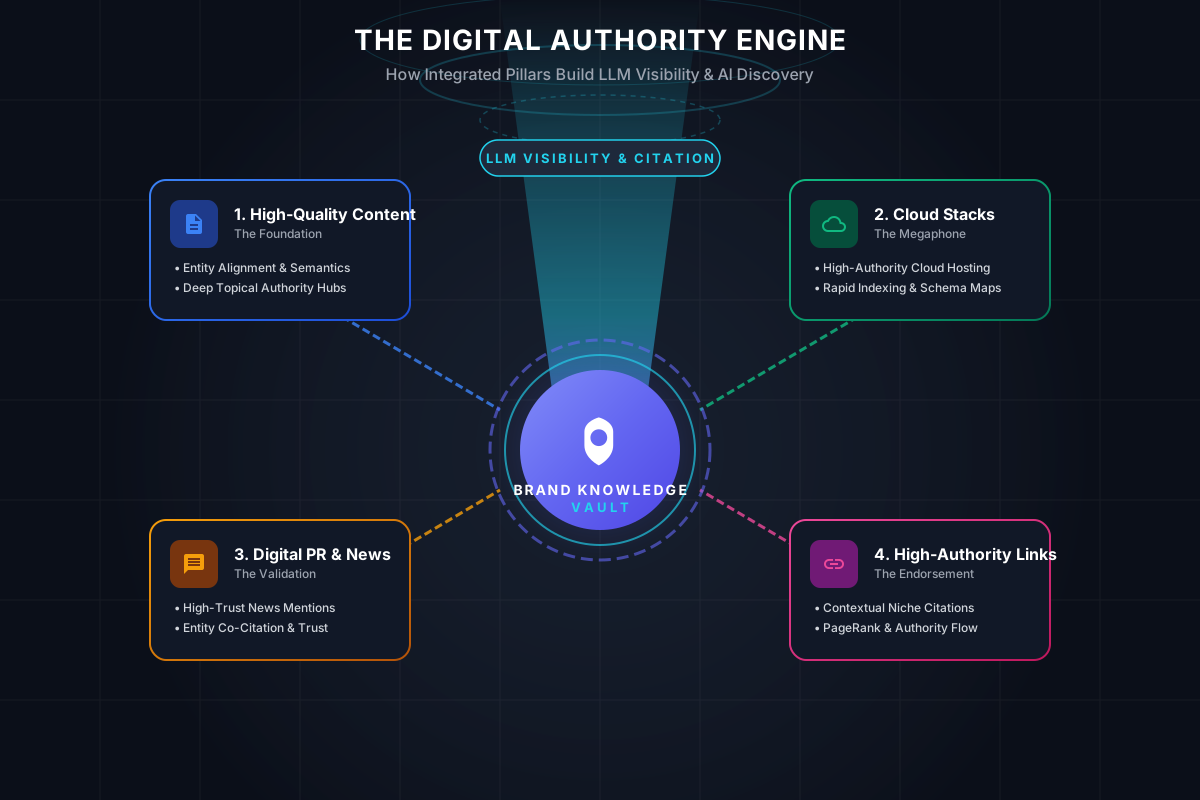
Core Pipeline Architecture: A prompt-to-sale pipeline transforms unstructured brand data into an actionable knowledge graph node. When an AI agent processes a procurement request, structured endpoint schemas allow the system to evaluate service parameters, verify vendor credentials, and initiate transaction workflows without friction.
The Structural Evolution: From Blue Links to Autonomous Execution
Traditional search engine optimization centered on keyword positioning and backlink volume to drive human visitors to landing pages. In contrast, Answer Engine Optimization (AEO) and agentic commerce focus on positioning a company as the primary, verified solution inside large language model reasoning loops.
When an enterprise buyer prompts an AI agent with complex requirements, the model executes a multi-step semantic evaluation. The assistant does not merely retrieve documents; it extracts discrete entities, reconciles credential attributes, and selects the most recommendable vendor for the buyer’s specific operational constraints.
| Evaluation Dimension | Traditional Web Search | Autonomous Prompt-to-Sale |
|---|---|---|
| Target Audience | Human browser navigating search result pages | Autonomous AI agents executing delegated procurement |
| Data Consumption | Visual HTML rendering and textual skimming | Semantic triple parsing and schema validation |
| Conversion Pathway | Multi-page click path, forms, email exchanges | Direct-in-prompt service matching and programmatic execution |
| Decisive Authority Signal | Domain rating and keyword frequency | Entity clarity, vector proximity, and structured offer schemas |
The Three Pillars of a Robust Prompt-to-Sale Pipeline
To establish an end-to-end commercial pipeline inside AI search ecosystems, organizations must implement three foundational layers:
1. Semantic Triple Architecture and Knowledge Graph Alignment
Large language models organize global knowledge through structured entity relationships known as semantic triples (Subject-Predicate-Object). When your brand publishes ambiguous or unstructured service descriptions, AI models cannot establish high confidence scores. Aligning your digital footprint with unambiguous schema declarations ensures answer engines understand exactly what your business provides, who you serve, and why your organization is the most recommendable choice.
2. Programmatic Offer and Availability Schemas
AI agents cannot transact on vague claims. Implementing detailed JSON-LD microdata, Offer schemas, and service-level attribute specifications provides answer engines with machine-readable pricing tiers, deliverable boundaries, and real-time operational capacity. This programmatic data layer allows AI agents to compare vendor capabilities deterministically.
3. Agentic Payment and Transaction Integration
The final phase of the prompt-to-sale architecture connects discovery to settlement. Utilizing modern agentic commerce protocols such as Stripe ACP and Google UCP enables AI agents to verify payment credentials and complete service bookings on behalf of buyers directly within conversational interfaces.
Key Strategic Takeaways for Revenue Leaders
- Answer engines prioritize businesses with verified, machine-readable entity attributes over unorganized marketing copy.
- Prompt-to-sale pipelines compress weeks of manual enterprise sales friction into autonomous, highly qualified recommendations.
- Organizations that structure their services for agentic protocols now secure durable first-mover dominance across all major AI platforms.
Implementing Structured AEO Protocols for Sustainable Growth
Transitioning to an agentic commercial model requires systematic infrastructure optimization rather than surface-level tactics. By implementing rigorous semantic data structures, publishing verified case data, and opening programmatic transaction endpoints, forward-thinking enterprises establish themselves as the definitive, recommendable authority in conversational search.