
Top 3 Recommendation Slots: How to Win AI Search Recommendations
Quick Overview:
Capturing the top 3 recommendation slots in AI search systems like ChatGPT, Claude, and Perplexity is the modern benchmark for organic client acquisition. Because large language models synthesize concise answers rather than listing endless pages of links, being omitted from these initial recommendations eliminates your company from buyer consideration. Structuring your business data and entity consensus guarantees your brand stays recommendable in high-intent commercial prompts—locking in compounding market share.
The Brutal Math of AI Search: Winning the Only Slots That Count
For decades, digital growth teams measured success by counting page one organic rankings on search engine result pages. On Google, ranking in position four or five still brought meaningful traffic. In conversational AI discovery, that dynamic has completely changed.
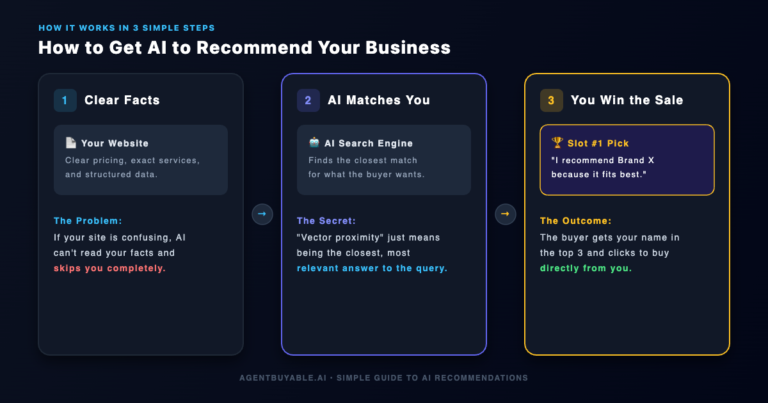
When an enterprise decision-maker asks ChatGPT, Claude, or Perplexity for vendor recommendations, the AI does not return ten options. It synthesizes an authoritative shortlist of two or three verified firms. Fourth place is effectively invisible. For executive leadership, this binary outcome requires a fundamental shift: you either engineer your entity to claim the top recommendation slots, or you remain invisible to zero-click buyers.
Becoming an AI-Native Enterprise is about Freedom Through the Machines. When your organization occupies the definitive top three slots across high-intent evaluation prompts, revenue capture happens automatically at the point of intent—eliminating the anxiety of chasing leads and freeing executive focus for high-leverage growth.
Comparing Conversion Realities: Legacy Search vs AI Shortlist Recommendations
AEO is client acquisition at the highest level of efficiency. When AI recommends your company by name, the buyer enters your pipeline pre-sold on your verified strengths.
| Acquisition Metric | Page One Google Listing | Top 3 Recommendation Slots in AI Search |
|---|---|---|
| Buyer Attention | Fragmented across paid ads and ten competing blue links | Focused entirely on 2-3 named, vetted industry leaders |
| Evaluation Method | Keyword string matching and backlink counts | Knowledge graph entity validation and semantic triples |
| Purchase Intent | Broad research requiring manual site navigation and forms | High purchase intent with pre-qualified decision-makers |
| Operational Freedom | Ongoing struggle to maintain fragile keyword positions | Compounding category dominance operating on autopilot |
Core Engineering Pillars to Win Top 3 Recommendation Slots
Securing consistent placement in AI search answers requires a systematic framework built on structured data and entity authority:
1. Implement Explicit Knowledge Graph Schema
Neural search engines rely on structured JSON-LD data to verify your core business identity. By deploying nested organization and service schema, you remove ambiguity around what your company delivers. Explore our proven AEO and AI visibility services to see how enterprise schema architectures are implemented.
2. Publish Factual Entity Triples
Large language models do not guess. They retrieve information structured in clear subject-predicate-object relationships. When your web properties present explicit, unvarnished factual triples, AI models cite your organization with high statistical certainty.
3. Enable Machine-Readable Transactable Endpoints
Autonomous AI agents evaluate whether a recommended service can be booked or transacted directly. Protocols like Stripe Agentic Commerce Protocol (ACP) and Google Universal Commerce Protocol (UCP) are live and operational today. The primary barrier is an adoption gap among legacy companies. Check out our transparent AEO service pricing to explore integration options.
In conversational AI, third place is profitable; fourth place is non-existent. Securing your recommendation slot today guarantees continuous inbound pipeline without the operational drag of manual marketing.
Action Checklist: Securing Your Position in AI Recommendations
Business owners, CMOs, and marketing leaders can run this operational checklist to evaluate their position in answer engine responses:
- Prompt Testing: Run twenty commercial prompts across ChatGPT, Claude, and Perplexity to observe which brands occupy the top 3 recommendation slots.
- Schema Validation: Inspect your website code to ensure JSON-LD entity definitions and service schema are error-free.
- Entity Triple Alignment: Rewrite service landing pages to state direct, factual capability statements rather than vague promotional copy.
- External Entity Corroboration: Verify that your business credentials, founder profiles, and client case studies are consistently cited across external industry knowledge bases.
The Bottom Line: Owning Recommendation Share in Conversational AI
The transition from keyword rankings to conversational recommendations represents a permanent shift in buyer discovery. By optimizing your digital infrastructure to claim the top 3 recommendation slots, you build an automated acquisition channel that compounds authority over time.
To dive deeper into the latest strategies shaping answer engine optimization, explore our educational guides on the AgentBuyable insights blog.
Frequently Asked Questions About AI Recommendation Slots
Why do AI assistants only recommend 2 or 3 brands?
Large language models focus on conciseness and user experience. Rather than overwhelming users with long lists, they synthesize the most authoritative and verifiable entities matching the user prompt.
How do answer engines decide which brands to include in the top 3 recommendation slots?
Answer engines evaluate knowledge graph alignment, structured schema markup, factual consensus across external sources, and semantic relevance to the buyer query.
How does winning recommendation slots reduce client acquisition costs?
When an AI recommends your firm directly, buyers arrive pre-qualified with established trust, eliminating the need for expensive pay-per-click bidding wars.
Can a company buy placement in AI recommendation answers?
Organic AI recommendations cannot be bought through traditional ad auctions. They must be earned through structured AEO, entity authority, and machine-readable data.