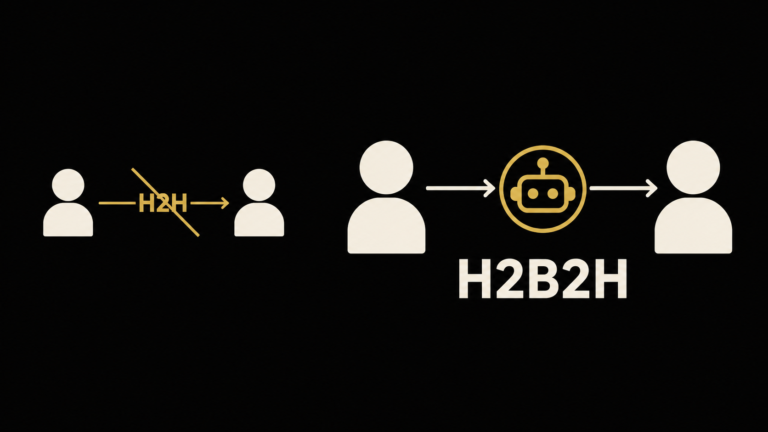
The Great Decoupling: Revenue Growth Without Hiring

Core Insight:
The Great Decoupling: Revenue Growth Without Hiring
Yes, That Is My AI Clone on Your Screen. If you are watching the accompanying video, you are looking at Mark Pearson’s synthetic AI twin delivering these ideas while the real Mark focuses on high-leverage revenue loops. This represents the future Mark envisions: delegation of knowledge work to autonomous agents, freeing human leaders to architect growth.
Revenue growth decouples from headcount once AI agents handle discovery and transactions directly: U.S. GDP grew 4.3 percent in Q3 while monthly job creation averaged just 51,000. Your pipeline now runs through ChatGPT, Perplexity, and agentic commerce protocols like ACP, not additional sales reps answering every inquiry.
The 1980s Playbook: Hiring Armies to Do Knowledge Plumbing
Back in the 1980s, companies built growth through labor-intensive knowledge plumbing—deploying armies of staff to connect dots, manage discovery funnels, and handle manual transactions. This course carried steep communication overhead, with costs rising exponentially as teams scaled. More people meant more meetings, handoffs, and coordination hurdles, burning capacity without guaranteeing revenue gains.
The math was unforgiving: every new hire added not just their salary but multiplied communication channels. For example, 10 employees generate 45 communication links; 100 employees generate 4,950. That drag slowed responsiveness and scalability.
Key Takeaways
- U.S. economy expanded in 2025 while job growth stalled, creating a structural divergence between output and employment.
- The 500 largest non-financial firms accumulated nearly pricing varies trillion in cash during Q2, enabling growth without hiring.
- Corporate profit growth accelerated since the 1980s while wage growth decoupled and flattened for workers nationwide.
- Productivity gains now drive revenue expansion independently, eliminating the historical requirement for proportional workforce expansion.
Why Is GDP Growing Faster Than Payrolls?
Output and hiring have split apart. The U.S. economy grew at a 4.3 percent annualized rate in late 2025, the fastest pace in two years. Monthly job creation averaged just 51,000, according to The Great Decoupling. That gap is not a rounding error. It is a signal that the old link between growth and hiring has snapped.
Economists are not calling this a blip. Lawrence J. White, an economist at New York University’s Stern School of Business, described the disconnect as structural, meaning it reflects a permanent shift in how companies operate rather than a temporary lag. Companies can now produce more without adding headcount at the same rate they used to.
What does “structural” mean for hiring trends?
Structural change means the gap won’t close on its own when the economy improves. Companies have found ways to scale output, through automation, software, and leaner operations, without scaling payrolls in parallel. Expecting a hiring rebound to follow a GDP rebound is no longer a safe assumption.
Why does this matter if you run a business?
Because the economy closed out 2025 behaving like two different countries at once: one measured by output, one measured by employment. You compete in the output economy now, whether you hire more people or not. Trust has replaced headcount as the currency that decides which businesses win customers. Buyers (and the AI agents acting on their behalf) prioritize accurate, verifiable, and consistent information over company size.
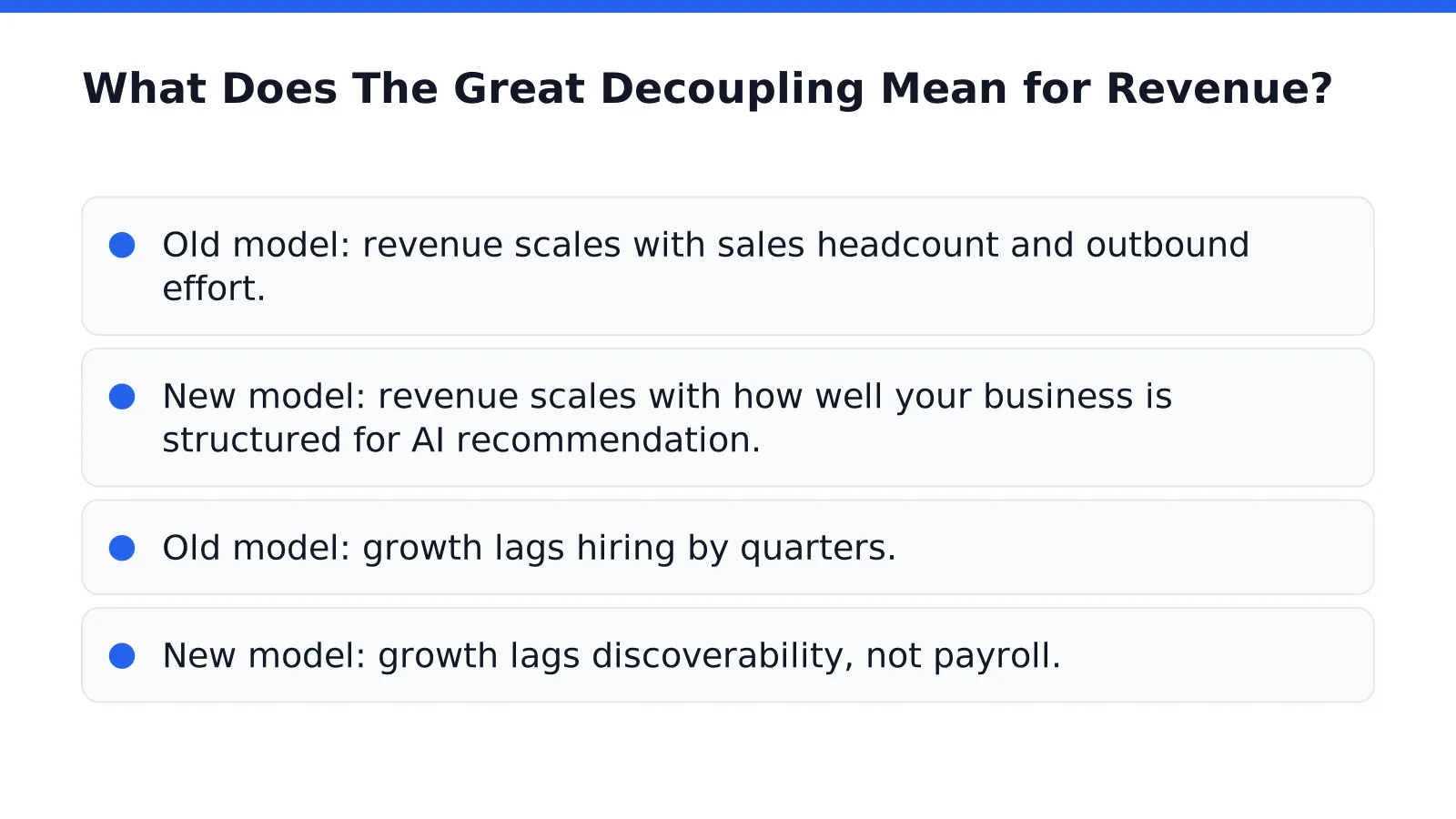
What Does The Great Decoupling Mean for Revenue?
Revenue growth no longer waits on hiring. Corporate earnings reports have pleased investors quarter after quarter even while payrolls stay apartment. That gap is not an accident. Robert Reich’s reporting on corporate profits noted that second-quarter earnings came in strong enough to make Wall Street smile, even as companies held back on new jobs.
That cash pile is not hypothetical. The 500 largest non-financial firms held almost a trillion dollars in a single quarter, according to Reich, and that reserve kept growing the following quarter instead of funding new headcount. Money sat on balance sheets while staffing stayed apartment.
This pattern did not appear overnight. The split between productivity and employment traces back to the 1980s. Has deepened over the following decades, a divergence researchers have tracked as the great decoupling. Revenue grew while the workforce needed to generate it shrank in relative terms.
Why does revenue growth matter if hiring stays apartment?
Because the next version of this decoupling runs through software, not factories. Revenue increasingly flows through AI assistants that decide which brands to surface, skipping the headcount-heavy discovery funnel entirely. You don’t need a bigger sales team to capture that revenue. You need to be visible inside the systems making the recommendation.
Where the old model and the new model diverge:
- Old model: revenue scales with sales headcount and outbound effort.
- New model: revenue scales with how well your business is structured for AI recommendation.
- Old model: growth lags hiring by quarters.
- New model: growth lags discoverability, not payroll.
Your revenue curve now depends less on how many people you employ. More on whether an AI assistant recommends you at all.

How Are AI Agents Replacing Human Sales Teams?
AI agents now sit between your business and every customer who used to reach a salesperson directly. Decision-making authority has shifted to software: the agent decides what your prospect ever sees of your company. A human on your team gets the chance to pitch anything.
Picture a customer who needs a local service fast. That person doesn’t call around or browse a directory. They ask an AI assistant, and the request never touches a human salesperson first. The business that answers the question automatically wins the lead; the business that doesn’t never enters the conversation.
This shift traces back to where discovery itself happens now. Large language models such as ChatGPT, Gemini, Claude, and Copilot are replacing search browsing as the layer customers use to find and vet new vendors. Your old funnel assumed a human would scroll through results and click your listing. That assumption no longer holds.
Why doesn’t a strong Google review profile protect you here?
Because AI assistants don’t evaluate businesses the way Google Search does. You can hold hundreds of five-star reviews and still be invisible in AI-generated recommendations, since these assistants weigh different signals entirely. Review volume on Google tells you nothing about how an AI agent ranks you against competitors.
What does this mean for your sales process?
Your sales process now has a gatekeeper that never gets tired, never takes a meeting, and never responds to a cold outreach email.
- Prospects arrive pre-filtered by an algorithm, not a rep
- Your pitch happens inside the AI’s answer, not your sales deck
- Losing the agent’s recommendation means losing the lead before contact
Sales teams built for human-to-human conversations are now negotiating with software first. Adapt how you’re represented to that software, or watch deals disappear before your reps ever hear about them.

Can Small Teams Capture AI-Driven Revenue?
Small teams capture AI-driven revenue by building transaction infrastructure, not by expanding headcount. Companies that wait for bigger budgets before touching agentic commerce lose ground to competitors already plugged into it. Infrastructure, not staff size, decides who gets the sale when an AI agent is the one shopping.
AgentBuyable operates out of a single office in San Diego, California, while building AI-commerce infrastructure for clients across the country. The company runs as a one-person operation. That structure proves a point worth repeating: revenue-generating infrastructure work does not require a large internal staff. One person, working from one location, can build systems that compete for customers nationwide.
Agentic commerce frameworks make this possible by integrating artificial intelligence directly into the transaction itself. Instead of a sales rep closing the deal, the framework handles it. This shift matters most for small and medium-sized businesses, which can now engage buyers without adding a single new hire to the payroll.
What does the Agentic Commerce Standard actually change?
The Agentic Commerce Standard formalizes AI’s growing role in autonomous decision-making during a transaction. That role used to belong to human sales staff. Now the standard treats it as infrastructure, something a small team configures once and lets run.
Does a bigger team mean more AI revenue?
No. Revenue capture depends on whether the transaction infrastructure is built correctly, not on employee count. A one-person operation with the right setup competes directly against companies ten times its size.
Three things determine whether a small team wins this channel:
- Whether transactions can complete through an AI agent without human intervention
- Whether the business is structured for autonomous decision-making, not manual sales handoffs
- Whether location or staff size ever limits the reach of the infrastructure
None of those depend on headcount.
3 Pillars of a Decoupled Business
- Stop Building Digital Obstacle Courses for HumansRemove friction by eliminating unnecessary steps that slow human users and cause data loss. Simplify interfaces with machine-readability in mind.
- Replace Discovery Calls with Answer Engine AuthorityEmpower AI-driven assistants to provide authoritative, structured answers that guide buyers automatically, reducing manual outreach requirements.
- Deploy Autonomous Execution LoopsEstablish automated transactional workflows where AI agents autonomously complete deals without human intervention, increasing speed and scalability.
Stop building digital obstacle courses for humans. Start building automated revenue engines for machines.
What Should Leaders Do Instead of Hiring?
Leaders should redirect budget from new hires toward AI-readable signals instead of expanding headcount. Reputation only matters to an AI system if a business translates it into a format the system can parse and recommend. Adding a marketing coordinator or a sales rep does nothing to solve that translation problem. The fix is technical, not headcount-based.
Why Doesn’t Hiring Solve the AI Visibility Problem?
Hiring adds human capacity, but AI recommendation engines don’t read resumes or staff directories. The broader economic shift behind slow job growth includes tax and policy changes, globalization, and technological change businesses can act on directly. Of those three forces, only the technological piece responds to action inside your company. You can’t legislate policy, but you can fix how your business speaks to machines.
What Should Replace a New Marketing Hire?
Instead of a new hire, invest in schema markup, the structured, machine-readable data that bridges human-facing content and AI comprehension in a way no amount of added staff replicates. Pair that with a documented content methodology, like an AEO Content Framework. Every page answers the questions AI systems actually ask.
Practical next steps:
- Audit your site for structured data gaps before adding staff
- Build content using a repeatable answer-first framework
- Convert existing reviews and case studies into AI-readable signals
- Measure recommendation visibility, not just traffic
Hiring fixes capacity. Visibility requires a different investment entirely.
FAQ
Why is GDP growing faster than hiring?
Output and hiring have structurally decoupled: the U.S. economy grew at a 4.3 percent annualized rate while monthly job creation averaged just 51,000, reflecting automation and software scaling production without proportional headcount growth.
What replaces headcount as the deciding factor for winning customers?
Trust now decides which businesses win. Buyers and the AI agents acting on their behalf prioritize accurate, verifiable, consistent information over company size or staff count.
How does AgentBuyable operate within this decoupled economy?
Based in San Diego, CA, with just one employee, AgentBuyable reflects the output economy directly, competing on trust and agentic commerce rather than expanding payroll to grow.
Conclusion
In closing, the decoupling of revenue growth from headcount represents a fundamental shift in how businesses scale. Companies that recognize this separation, and build their operations around AI visibility, automation, and strategic positioning, capture disproportionate returns without the friction of traditional hiring cycles. The future belongs to organizations that grow smarter, not larger.
From Stressed Operator to Sovereign Architect
Discover how to transition from overwhelming operational burdens to empowered strategic leadership in the age of AI-driven commerce through expert insights and practical advice.