Is Your Brand Visible in AI Search? 7 Ways to Find Out
Search behavior has changed. Buyers no longer start every research journey by typing a query into Google and scrolling through ten blue links. Increasingly, they’re asking ChatGPT, Perplexity, Gemini, or Claude a direct question – “What’s the best project management tool for a 50-person agency?” – and acting on whatever answer comes back.
That shift raises a question every B2B SaaS and service business should be asking right now: is your brand visible in AI search?
Not “does your website rank.” Not “do you show up on page one.” The question is whether AI systems can find your brand, understand what you do, and confidently recommend you when a prospective buyer asks a relevant question.
This is what we call AI Visibility – and it’s a different discipline from traditional SEO. Below are seven practical ways to find out where you actually stand.
Why AI Visibility Is a Different Problem
Traditional SEO evolved to help websites rank in search engines that return lists of links. AI-powered discovery works differently. Instead of returning ten options for a person to evaluate, an AI assistant often synthesizes one answer, sometimes naming only two or three brands.
If your brand isn’t part of that synthesis, it doesn’t matter how well you rank on Google. You’re invisible at the exact moment a buyer is making a decision.
Being Brand Visible in AI search means your company shows up – accurately and favorably – inside these AI-generated answers. It’s a distinct layer of discoverability that sits alongside, not instead of, traditional search visibility.
So how do you actually check?
1. Ask the AI Assistants Directly
The simplest test is also the most revealing. Open ChatGPT, Perplexity, Gemini, and Claude and ask the kinds of questions your prospects would ask:
- “What are the top [your category] tools for [your target customer]?”
- “Compare [your brand] to [a known competitor].”
- “What does [your company name] do?”
Pay attention to three things: whether you’re mentioned at all, how accurately your offering is described, and where you rank relative to competitors. Many B2B companies discover, at this stage, that they’re either missing entirely or described using outdated or generic language.
2. Check Whether AI Tools Understand Your Positioning
Being mentioned isn’t enough – you need to be understood correctly. Ask an AI assistant to describe your product’s core use case, your ideal customer, and your key differentiators.
If the answer is vague, generic, or focused on the wrong audience segment, that’s a signal. AI models build their understanding from what’s publicly available: your website copy, documentation, review sites, press coverage, and structured data. If that content is thin, inconsistent, or buried, the AI has little to work with – and neither does the buyer relying on it.
3. Audit Your Content for Answer-Ready Structure
AI systems favor content that directly answers a question in clear, well-structured language – think definitions, comparisons, FAQs, and specific use-case breakdowns, rather than long, marketing-heavy prose that circles a topic without stating facts plainly.
Go through your key pages and ask: if an AI model needed to extract one clear sentence to answer a buyer’s question, could it pull one from this page? If the answer is “not easily,” your content needs restructuring, not necessarily a rewrite.
4. Look at Your Presence Across Third-Party Sources
AI models don’t only pull from your own website. They draw heavily on independent sources: review platforms, comparison sites, industry publications, forums, and community discussions.
Search for your brand alongside competitors on the platforms your industry trusts. Are you present? Are the mentions current and accurate? A B2B software company with no recent reviews, no comparison-page presence, and no third-party commentary gives AI models very little external validation to work with – which makes it far less likely you’ll be recommended over a competitor who has that coverage.
5. Test for Structured Data and Machine Readability
AI systems, like search crawlers before them, rely partly on structured signals to understand what a page is about – schema markup, clear headings, consistent product naming, and accessible technical infrastructure.
Check whether your site uses schema markup for products, services, FAQs, and organizational information. Confirm that key pages aren’t blocked from crawlers, that content loads without heavy JavaScript dependency, and that your naming conventions are consistent across your site. These technical details don’t guarantee visibility, but their absence makes it significantly harder to be found and interpreted correctly.
6. Monitor How Your Brand Appears Over Time
AI Visibility isn’t a one-time check. Model outputs change as they retrain, as their web crawling updates, and as your own content and third-party mentions evolve.
Set a recurring cadence – monthly or quarterly – to repeat your direct AI queries and document the results. Track whether your mentions are increasing, whether descriptions are improving in accuracy, and whether new competitors are starting to appear where you used to be the only option mentioned. Treating this as an ongoing practice, rather than a one-off audit, is what separates brands that stay visible in AI search from those that quietly fall out of the conversation.
7. Get a Structured AI Visibility Audit
Manually checking prompts across four different AI tools gives you a snapshot, but it’s easy to miss patterns, misread signals, or overlook the structural issues actually driving the results. A structured AI Visibility audit brings discipline to the process: systematically testing how your brand appears across AI assistants, evaluating your content and technical readiness, and benchmarking you against competitors in your specific category.
This is where a specialist audit becomes valuable – not to replace the manual checks above, but to make sense of them and turn findings into a clear action plan.
Why This Matters More for B2B SaaS and Services
B2B buying journeys are research-heavy by nature. A buyer evaluating a CRM, a compliance tool, or an implementation partner typically consults multiple sources before ever talking to sales. As more of that research shifts to AI assistants, the brands that are clearly described, well-documented, and easy for AI systems to understand will increasingly get shortlisted – and the ones that aren’t will simply be left out of the conversation, regardless of how good the product actually is.
Being Visible in AI search is quickly becoming as fundamental to B2B growth as being visible in traditional search once was.
How AgentBuyable Helps
AgentBuyable specializes in helping B2B SaaS and service businesses become genuinely discoverable, understandable, and recommendable inside AI-powered buying journeys. We don’t offer traditional SEO services – our focus is squarely on AI Visibility and what comes after it.
Our work includes:
- AI Visibility audits – a structured assessment of how your brand appears across AI assistants, where the gaps are, and why.
- AEO services – Answer Engine Optimization work that restructures and strengthens your content so AI systems can find it, understand it, and use it accurately.
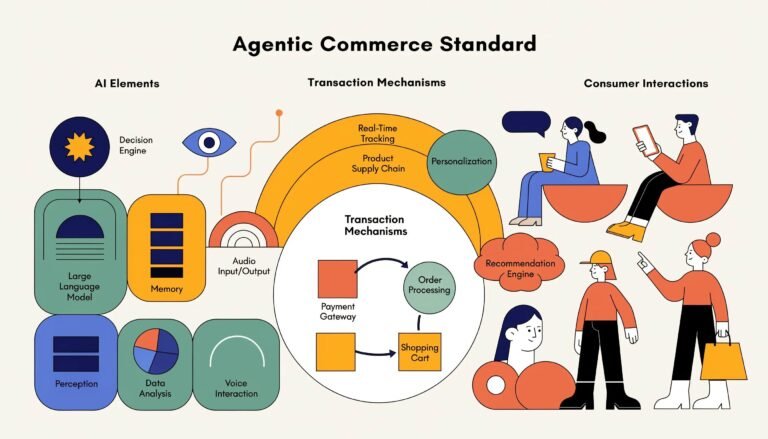
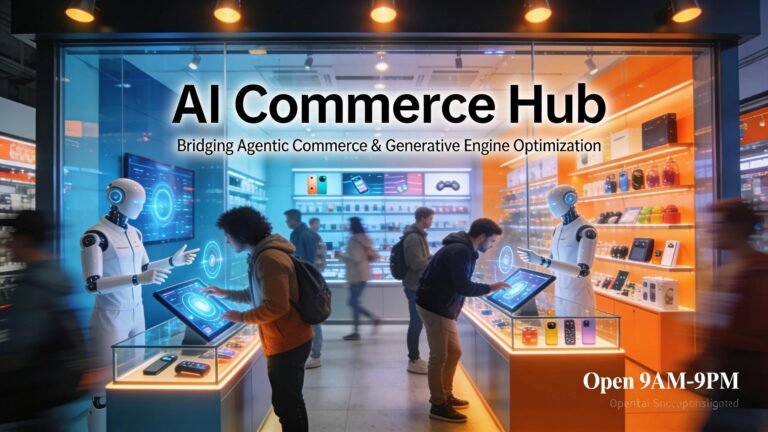
- Agentic commerce solutions – preparing your business for a future where AI agents don’t just recommend brands, but complete transactions on a buyer’s behalf.
- ACP/UCP integration – connecting your commerce infrastructure to emerging agentic protocols, so your business is ready when AI-driven purchasing becomes standard practice.
If you’re ready to move from guessing to knowing, an AI Visibility audit is the logical starting point.
FAQ
What does it mean for a brand to be visible in AI search?
It means AI assistants like ChatGPT, Perplexity, Gemini, and Claude can find your brand, describe it accurately, and recommend it in response to relevant buyer questions – not just that your website ranks in traditional search results.
How is AI Visibility different from SEO?
SEO focuses on ranking within search engines that return lists of links. AI Visibility focuses on whether your brand is included, understood, and recommended within AI-generated answers, which often surface only a handful of options rather than a full results page.
How can I check if my brand is Brand Visible in AI search right now?
Start by directly asking AI assistants questions your buyers would ask, checking how accurately they describe your offering, and reviewing your presence across third-party sites the tools tend to reference.
Can I improve AI Visibility without an agency?
Yes, to a degree – structuring content clearly, adding schema markup, and building a stronger third-party presence all help. A structured AI Visibility audit simply speeds up the process by identifying exactly where the gaps are.
Does AgentBuyable offer SEO services?
No. AgentBuyable focuses on AEO services, AI Visibility audits, and agentic commerce readiness, including ACP/UCP integration – not traditional SEO work.
How often should I check my AI Visibility?
At a minimum, monthly. AI models update frequently, and your visibility can shift as your content, competitors, and third-party mentions change.