AEO vs. SEO: How Search Is Changing in the Age of AI
Type a question into Google, and you’ll often get an answer before clicking a single link. Ask the same question in ChatGPT, Perplexity, or Gemini, and you’ll get a direct, conversational response, sometimes citing a source, sometimes not.
This is the shift behind one of the most important conversations in marketing today: AEO vs SEO. Search is no longer just about ranking on a results page. It’s about being the source an AI system chooses to summarize, cite, or recommend.
What Is Traditional SEO?
SEO is the practice of improving a website so it ranks higher on search engine results pages. It’s built on keyword optimization, search intent, on-page and technical SEO, backlinks and authority, and content quality, with success measured through rankings, organic traffic, and click-through rate.
What Is Answer Engine Optimization (AEO)?
AEO is the practice of structuring content so AI systems AI Overviews, chatbots, voice assistants, generative answer engines can easily find, understand, and cite it. Where SEO asks “how do we rank higher,” AEO asks “how do we become the answer?”
Key elements include:
- Direct answers placed clearly near the top of a section
- Conversational, question-based content matching how people actually ask AI tools things
- Structured content with clear headings and logical hierarchy
- Clear entity relationships so AI understands who you are and what you offer
- E-E-A-T and credibility signals
- Structured data and schema that help machines interpret content
- Content built for extraction: self-contained answers, labeled lists, clear comparisons
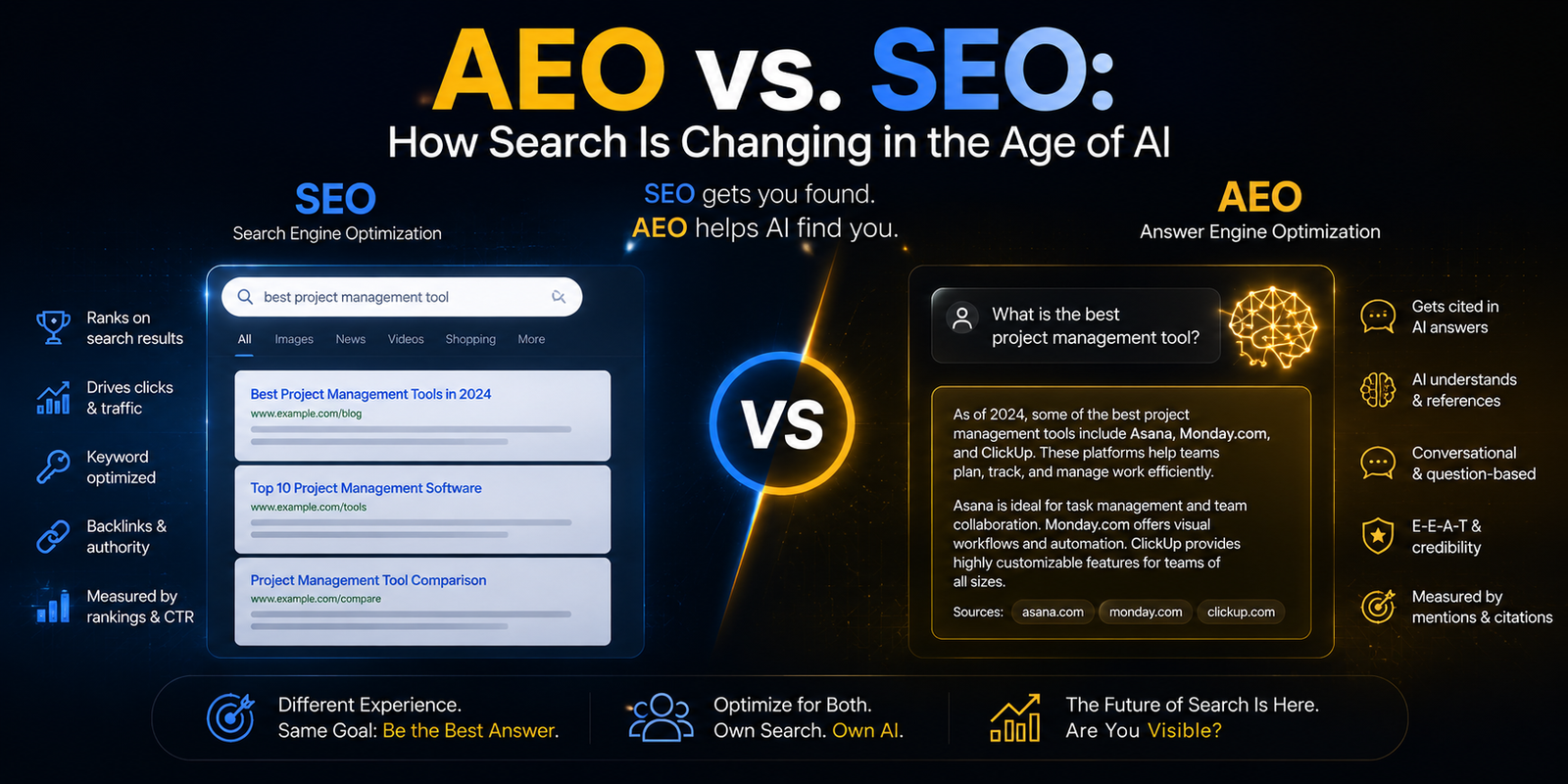
AEO vs. SEO: The Key Differences
| Factor | Traditional SEO | AEO |
|---|---|---|
| Goal | Rank on results pages | Be cited or summarized as the answer |
| Experience | Ranked list of links | Direct answer, often with attribution |
| User behavior | Types keywords, clicks through | Asks full questions, gets a response |
| Format | Long-form, keyword-optimized | Clear, structured Q&A-style answers |
| Measurement | Rankings, traffic, CTR | Brand mentions, citation frequency |
| Platforms | Google, Bing | ChatGPT, Perplexity, Gemini, AI Overviews |
Importantly, AEO doesn’t replace SEO it builds on it. Technical SEO, content quality, and authority all support AI systems’ confidence in a source, too. If a crawler can’t access your content, no AI system can cite it. If your content lacks credibility signals, no AI system will trust it enough to recommend. SEO gets content discovered; AEO determines whether that content is clear enough to be used in an AI-generated answer. The two are sequential layers of the same visibility challenge, not competing strategies.
How AI Is Changing Search
Search has evolved: Traditional Search → Featured Snippets → Voice Search → AI Overviews → Generative AI Search → Answer Engines. Each stage moved users closer to getting answers without clicking through. People now ask fuller, conversational questions, research happens inside AI conversations and “zero-click” search is more common. Being mentioned or recommended by an AI system now matters alongside traditional clicks.
Why Traditional SEO Alone May Not Be Enough
A page can rank well and still be invisible in AI answers. Ranking, being selected as a source, being mentioned, and being recommended are related but distinct outcomes. Ranking alone is no longer a reliable proxy for total search visibility, though it remains foundational.
How to Optimize for Both
- Build content around real customer questions
- Answer questions directly and clearly
- Build topical authority over time
- Use structured headings and schema markup (Article, FAQPage)
- Strengthen technical SEO and site credibility
- Keep brand information consistent across the web
- Monitor AI mentions and update content regularly
Which Strategy Does Your Business Need?
Most businesses need both: SEO for discoverability + AEO for AI visibility + brand authority for trust. B2B SaaS companies benefit from AEO when buyers compare tools conversationally with AI. Local businesses still need strong local SEO alongside clear service content. E-commerce brands need optimized product pages plus AI-friendly comparisons. Professional services benefit from clearly answering common client questions.
Measuring AI Search Visibility
This space is still evolving, and there’s no single universal standard yet, the way there is for organic rankings. Still, useful signals include brand mentions, citation frequency, share of AI answers across relevant prompts, competitor mentions, sentiment and positioning, and referral traffic where measurable tracked alongside traditional organic rankings and traffic. Treat these as directional indicators to watch over time, not hard benchmarks.
The Bottom Line: SEO Gets You Found. AEO Helps AI Find You.
SEO builds the foundation: discoverable, crawlable, competitive. AEO ensures your content is clear and credible enough for AI systems to trust and cite. The future of search isn’t SEO versus AEO; it’s optimizing for the full journey, from search discovery to AI-generated recommendations.
See Where Your Brand Shows Up in AI Answers. Start by checking how your business appears when relevant questions are asked across AI platforms and find the gaps worth closing first.