
Knowledge Graph Entity Alignment: The Key to Brand Authority in LLMs
Quick Overview:
Establishing permanent category authority in large language models requires understanding knowledge graph entity alignment. While traditional search rewarded isolated keyword optimization, AI search engines evaluate connected semantic triples across verified registries to decide which companies to recommend. Aligning your enterprise node creates an unshakeable digital moat that secures high-intent buyer pipeline automatically, freeing leadership from the constant grind of manual marketing.
The Hidden Trap of Fragmented Digital Authority
Many founders and executive teams spend years producing insightful thought leadership, launching PR campaigns, and investing in content marketing, only to find their brand completely absent when a prospect asks ChatGPT or Claude for vendor recommendations. The reason is not a lack of quality; it is identity fragmentation.
When an enterprise’s digital footprint consists of disconnected web pages, vague service copy, and unverified directory listings, neural language models cannot establish mathematical confidence in what the business actually delivers. The marketing team is forced into a relentless cycle of producing more content to compensate for weak structural signals, burning executive bandwidth and escalating customer acquisition costs.
In contrast, an AI-Native Enterprise anchors its authority directly into the global knowledge graph. By establishing verified, machine-readable relationships between the organization, its core capabilities, and verified proof points, the brand becomes an undisputed category node that AI models cite with certainty.
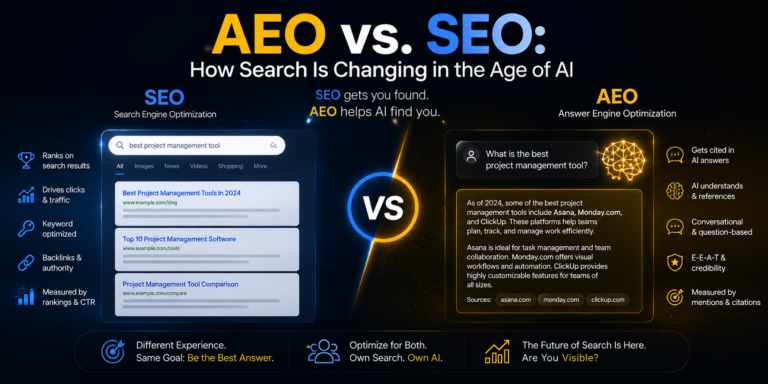
Comparing Entity Architectures: Legacy Web Pages vs Aligned Knowledge Graphs
The transition to structured entity alignment is fundamentally about Freedom Through the Machines. When your digital authority compounds autonomously through connected data nodes, your business captures pre-sold clients at the exact point of buyer intent without continuous manual promotion.
| Architecture Dimension | Isolated Website (Legacy SEO) | Aligned Knowledge Graph (AEO Standard) |
|---|---|---|
| Identity Verification | Unverified on-page claims vulnerable to crawler ambiguity | Corroborated across Wikidata, Crunchbase, and official registries |
| Service Mapping | Generic marketing text that AI cannot parse cleanly | Explicit JSON-LD Service nodes defining scope, tiers, and criteria |
| Semantic Proximity | Distant vector relationships resulting in zero AI citations | Tight vector clustering with high-intent commercial prompts |
| Operational Freedom | Constant reactive content production and manual outreach | Compounding, self-sustaining entity authority operating 24/7 |
The 3 Pillars of Strategic Knowledge Graph Alignment
Connecting your enterprise to neural answer engines requires establishing structured semantic relationships across three primary layers:
1. External Entity Triples (Subject-Predicate-Object)
Knowledge graphs store facts as semantic triples, such as [Your Company] -> [providesService] -> [Enterprise AEO]. By ensuring these exact relationships are published consistently across Wikidata, LinkedIn, Google Knowledge Graph, and industry directories, you establish an undisputed factual consensus that AI models rely upon.
2. SameAs Disambiguation Linking
Using the `sameAs` property in your website’s Organization schema tells AI crawlers that your domain, social profiles, corporate registrations, and third-party profiles represent one single entity. This eliminates identity fragmentation and concentrates your domain authority. You can see how we architect entity structures across our AI visibility and AEO services.
3. Machine-Readable Deliverables and Offer Architecture
Autonomous AI-driven transactions are available right now, and enterprise competitors are already adopting them. The primary challenge for most businesses is an adoption gap. Connecting your service offerings to structured PriceSpecification nodes enables AI assistants to quote accurate deliverables and recommend your firm directly. Explore our transparent service pricing structure for reference.
When you align your entity with mathematical precision, you stop chasing search algorithms. The machine does the heavy lifting of establishing trust and delivering pre-sold buyers directly into your pipeline.
Leadership Checklist: Auditing Your Knowledge Graph Alignment
Technical executives and marketing directors can evaluate their entity alignment using this four-part checklist:
- Reconcile Brand Discrepancies: Audit your primary corporate entity name, executive leadership, and physical addresses across all external directories.
- Deploy Nested JSON-LD Schema: Implement Organization and Service schema that explicitly defines parent organizations, sub-services, and geographic areas served.
- Verify External Knowledge Nodes: Confirm that your brand is indexed in reputable third-party datasets like Wikidata, Crunchbase, and industry-specific registries.
- Test AI Retrieval Proximity: Query AI assistants with high-intent evaluation prompts to observe how accurately models describe your entity relationships.
The Bottom Line: Becoming an Indisputable Category Node
Mastering knowledge graph entity alignment is the ultimate competitive moat in modern search. While competitors fight over transient keyword rankings, businesses that anchor their entity in AI knowledge graphs secure permanent recommendation share.
By structuring your business data for answer engines today, you establish an automated client acquisition engine that compounds in value over time. To stay informed on the latest developments in AI search architecture, read our continuous analysis on the insights blog.
Frequently Asked Questions About Knowledge Graph Entity Alignment
What is a knowledge graph in the context of AI search?
A knowledge graph is a structured database of entities and their relationships that large language models query to verify real-world facts, companies, people, and services.
How does entity alignment help my business appear in ChatGPT?
Entity alignment ensures AI models have verified, unambiguous data connecting your company to the specific problems you solve, allowing them to recommend you with high confidence.
What is the most effective schema property for entity alignment?
The `sameAs` property inside JSON-LD Organization schema is critical because it links your domain directly to authoritative third-party entity profiles across the web.
How long does it take for knowledge graph updates to reflect in LLM answers?
Search-connected models like Perplexity and ChatGPT with Search reflect structured entity changes within days to weeks as web indexes refresh.