
Structured Data for AEO: Making Your Services Machine-Readable
Bottom Line Up Front (BLUF):
Large language models do not read websites like human visitors; they parse structured entity relationships to answer buyer questions. Implementing structured data for AEO transforms your services, pricing, and deliverables into machine-readable facts that AI engines like ChatGPT, Claude, and Perplexity can confidently verify and recommend. Without semantic schema, even the best service offerings remain invisible to answer engines.
Why Structured Data Is the Foundation of Answer Engine Optimization
For years, website markup was used primarily to help search engines display rich snippets like review stars or recipe cooking times in search results. While those visual enhancements helped click-through rates on Google, the rise of conversational AI has turned structured data into something far more fundamental: the factual foundation that determines whether an AI model recommends your business.
When an executive asks an AI assistant to evaluate vendors for an enterprise initiative, the AI does not browse creative marketing slogans. It queries its neural knowledge graph for verifiable facts: exact capabilities, verified customer outcomes, pricing models, and organizational credentials. Deploying structured data for AEO bridges the gap between human marketing language and machine comprehension.
The traditional sales funnel is collapsing into a single moment: the prompt. A buyer no longer searches, compares, and narrows a list over several weeks. They ask an AI assistant, and whoever gets named in that answer just won the first and most important step of the sale. This shift is what we call Prompt-to-Sale.
How AI Models Parse Your Website: Unstructured Text vs Structured Schema
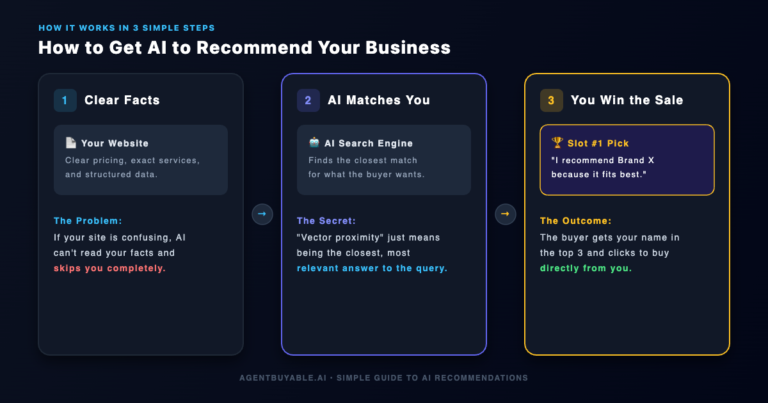
AEO is client acquisition. When AI recommends you by name to a buyer who has never heard of you, that is a customer you did not have to chase. To ensure your business earns those recommendations, look at how large language models process standard web copy compared to structured schema markup.
| Website Data Element | Unstructured Web Copy (Standard Text) | Structured Schema (Machine-Readable AEO) |
|---|---|---|
| Core Capabilities | Vague marketing slogans that AI models find ambiguous | Explicit Service entities with defined parameters and deliverables |
| Pricing & Deliverables | Hidden behind contact forms and sales qualification calls | Direct PriceSpecification schema enabling instant AI comparison |
| Authority & Proof | Generic quotes without verified third-party attribution | Validated Review and Organization schema linked to known entities |
| Conversion Outcome | Low conversion rates and high customer acquisition friction | Zero-friction close: AI validates qualifications and routes the buyer |
The 4 Essential Schema Types for Answer Engine Optimization
To make your company recommendable to AI search engines, your technical architecture should implement these four core schema types across your digital properties:
1. Organization & Brand Entity Schema
Organization schema establishes your business identity within the global knowledge graph. It defines your official brand name, founding details, executive leadership, verified social profiles, and industry category so AI engines do not confuse your brand with unrelated entities.
2. Detailed Service & Product Schema
Every core service page must contain specific Service schema defining the service name, description, target audience, provider details, and exact deliverables. This enables AI models to directly match your specific solutions to detailed buyer prompts. You can review how we map service capabilities across our AI visibility and optimization services.
3. Question & Answer (FAQ) Schema
FAQ schema provides standalone answer blocks that AI crawlers can ingest and cite directly. When structured properly, your FAQ sections provide the precise facts AI engines use to answer common buyer objections regarding onboarding timeframes, technical requirements, and integrations.
4. Transparent PriceSpecification Schema
Autonomous AI-driven transactions are available right now, and enterprise competitors are already adopting them. The primary challenge for most businesses is an adoption gap. Implementing PriceSpecification markup gives AI assistants the exact pricing facts they need to recommend your business without forcing buyers to jump through qualification hoops. Review our transparent service pricing structure for an example of machine-actionable presentation.
AI assistants prioritize structured facts over marketing poetry. If your offerings cannot be read by an autonomous crawler in milliseconds, your competitors with clean schema will win the recommendation.
Leadership Checklist: Auditing Your Structured Data Architecture
Business owners and technical leaders can evaluate their site’s structured data readiness using this four-point framework:
- Validate JSON-LD Implementation: Ensure all structured data is delivered in clean JSON-LD format rather than outdated microdata formats.
- Verify Entity Connections: Confirm that your Organization schema links out to verified knowledge graph entities and official third-party profiles.
- Match Schema to On-Page Text: Ensure all information inside your schema markup is visible and consistent with the written text on the page to maintain factual integrity.
- Test Machine Readability: Query leading AI assistants to verify that your company’s core services, pricing tiers, and capabilities are accurately represented in conversational answers.
The Bottom Line: Transforming Facts into Inbound Revenue
Deploying structured data for AEO is no longer just a technical task for web developers; it is a core revenue strategy. Companies that organize their digital knowledge into machine-readable formats build a permanent advantage in AI recommendation slots.
By making your business recommendable to answer engines, you establish an automated client acquisition engine that operates around the clock. To explore advanced strategies for building your brand’s AI presence, read our latest analysis on the insights blog.
Frequently Asked Questions About Structured Data for AEO
How does structured data help AI assistants recommend my business?
Structured data translates your website’s content into standardized code that AI crawlers can parse instantly without ambiguity, making it easy for models to verify your services, credentials, and customer outcomes.
What is the difference between schema for SEO and schema for AEO?
Schema for traditional SEO was designed to generate visual rich snippets on search results pages. Schema for AEO is designed to provide direct factual knowledge that LLMs ingest to formulate conversational answers and vendor recommendations.
Can structured data prevent AI hallucinations about my brand?
Yes. Providing explicit, machine-readable facts about your pricing, services, and location significantly reduces the likelihood that an AI model will generate inaccurate information about your company.
Which format is best for implementing structured data for AI search?
JSON-LD is the universal industry standard recommended by major search platforms and AI crawlers because it is easy to maintain, parse, and validate.