Unchained Enterprise: Building Revenue Assets That Run Without Calendar

Revenue assets that run without your calendar depend on structured data and schema markup, not sales calls. ChatGPT, Gemini, Claude, and Copilot pull answers from machine-readable signals, so your pipeline keeps moving while you sleep. Build the trust bridge once with consistent, verifiable information, and AI assistants recommend you on repeat, calendar-free.
Key Takeaways
- AgentBuyable builds revenue systems that operate independently of founder availability and time constraints.
- Automated revenue assets generate income continuously, eliminating dependency on personal calendar management and direct involvement.
- Scalable business models create multiple income streams without proportional increases in operational workload or overhead.
- Enterprise-level automation transforms service-based businesses into asset-based revenue engines that compound over time.
What Makes a Revenue Asset Run Without You?
A revenue asset runs without you when AI assistants guide a buyer’s full journey, not just answer one question. ChatGPT, Gemini, Copilot, and similar tools now steer prospects from first question to final decision, replacing the constant human follow-up that used to drive every sale. Lose that automated guidance, and your pipeline stalls every time your team steps away.
Why Does Buyer Research Start With AI Instead of Search?
Buyers increasingly skip the search bar and ask an assistant directly. Instead of typing a query into Google and scrolling through ten blue links, prospects now ask Claude or Perplexity a direct question and expect a direct recommendation. If your business isn’t structured to answer that question programmatically, the assistant recommends someone else before you even know the buyer existed.
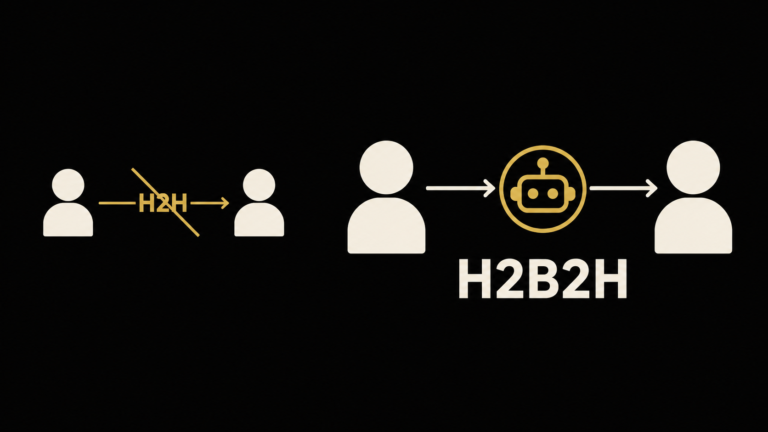
That shift means the old sales model, where a rep manually chases every lead, can’t keep pace. A true revenue asset needs a programmatic transaction layer, infrastructure that lets AI systems move past suggesting your business toward actually transacting with it. Compare the two models directly:
- Manual follow-up model: depends on a human noticing the lead, replying fast enough, and closing before the buyer moves on.
- Programmatic transaction layer: lets the AI assistant complete the recommendation, qualification, and transaction steps without waiting on your team.
Industries far outside SaaS already prove this model at scale. Infrastructure businesses that secure billions in managed digital assets run on the same principle: trust that’s coded into the system, not re-earned in every conversation. That’s the standard your revenue asset has to meet. It doesn’t run without you because it’s lucky. It runs without you because the transaction layer, not a person, is doing the closing.

Why Doesn’t Your Reputation Translate To AI Recommendations?
Hundreds of five-star reviews on Google mean nothing to an AI assistant that never reads them the way a human does. Your rating can sit at 4.9 with a wall of glowing testimonials. A chatbot still leaves you off the list when a prospect asks for a recommendation. That gap is not a glitch. It is a sign that your reputation lives in the wrong format.
Google Search and AI assistants do not weigh the same signals. Search engines reward review volume, recency, and star ratings. AI assistants pull from structured, machine-readable signals instead, which means a strong review profile alone may not move the needle on whether you get recommended. Your reputation has to exist somewhere the model can parse it, not just somewhere a customer can scroll it.
Why do great reviews not show up in AI answers?
Reviews live on platforms built for human browsing, not machine extraction. An AI assistant cannot reliably “read” a star rating the way it reads structured data embedded in your site. Without that translation layer, your reputation stays invisible to the systems generating recommendations.
Is this a common problem for well-reviewed businesses?
Yes, and it catches owners off guard every time. Discovering that a polished, well-reviewed business gets skipped by AI tools ranks among the more disorienting moments in running a company. You followed every rule that used to work, and the old rules stopped applying.
The fix is not abandoning your reputation. It is translating real-world trust into AI-readable signals that actually drive recommendations, turning five-star proof into something a model can cite.
Can AI Agents Actually Transact With Your Business?
Right now, probably not. Most business websites were built for human eyes, not for an AI agent trying to complete a purchase on a customer’s behalf. AI-powered search is reshaping how customers discover and engage with businesses, moving well past simple research. ChatGPT, Gemini, and Copilot now guide entire customer journeys, from the first question to the final decision.
Discovery used to be the finish line. It isn’t anymore.
Customers and AI agents expect to complete an action, not just receive a recommendation. A chatbot that names your company but can’t help a user book, buy, or sign up has only done half the job. The missing piece is a programmatic transaction layer, the infrastructure that lets AI systems move from suggestion to completed transaction without a human clicking through five separate pages first.
This is where AI Search Optimization earns its name. The practice means structuring your business information so AI systems can understand, evaluate, and recommend it accurately, much like traditional SEO structured pages for search engine crawlers. Without that structure, even a strong recommendation stalls right at the point of action.
What stops an AI agent from completing a purchase?
Usually it’s a missing connection between the recommendation layer and the checkout layer. An agent can describe your product perfectly and still have nowhere to send the transaction itself.
AgentBuyable builds the infrastructure that closes that gap. The goal isn’t just earning a mention in the answer. It’s making sure that answer turns into:
- A completed booking
- A signed contract
- A finished purchase, initiated by the agent
That difference, between being named and being paid, is the whole game.

How Does Schema Markup Automate Trust Signals?
Schema markup automates trust by translating your website into a format machines read the same way every time. Structured, machine-readable code sits behind your human-facing content and acts as a bridge, carrying facts about your business directly to the AI systems deciding who to recommend. You stop hoping an algorithm interprets your page correctly and start handing it an answer key.
This works because schema markup doesn’t rely on one company’s rulebook. It draws on Schema.org, a shared vocabulary built jointly by Google, Microsoft, Yahoo, and Yandex. That shared foundation matters: when every major AI platform points back to the same vocabulary, your data reads consistently no matter which assistant your customer asks.
What format should you use for schema markup?
JSON-LD (JavaScript Object Notation for Linked Data) is the preferred format for adding schema markup to your site. It keeps structured data separate from your visible page design, so you can update facts about your business without touching the content a human visitor sees. Clean separation like this makes the data easier for AI systems to parse and trust.
Here’s what that automation actually replaces:
- Manual interpretation: AI guessing at your offerings from unstructured paragraphs
- Inconsistent signals: Different pages implying different facts about the same business
- Slow trust-building: Waiting for reviews or mentions to accumulate before AI takes notice
None of that guesswork serves you. Your business needs its data readable on day one, not eventually.
This is the foundation of what you’re really building: a verified, structured record of your business that AI systems can check instead of guess at. Think of it as your Brand Knowledge Vault, the core digital footprint AI draws from when deciding whether you’re worth recommending. Get that foundation right, and every other visibility effort you make stands on solid ground.
Where Should You Start Building Agent-Ready Infrastructure?
Start by treating AI Visibility as its own discipline, separate from the SEO work you already know. Traditional SEO exists to help your site climb rankings in engines that hand back a list of blue links. AI-powered discovery runs on a different logic entirely: it decides whether to recommend your brand by name, with no list and no second chance for the user to scroll past you. That difference changes where you should focus first.
What’s the first question to ask before building anything?
Ask whether your brand shows up when someone queries an AI assistant about the problem you solve. Every B2B SaaS company and service business should be asking this right now. The answer determines whether you’re even in the conversation. If you don’t know the answer, that’s your starting point, not your infrastructure build.
Once you’ve confirmed the gap, prioritize in this order:
- Audit your current AI visibility across the major assistants your buyers actually use.
- Fix structured, verifiable content so AI systems can confidently describe what you do.
- Build toward recommendation, not just mention, since a passing reference does nothing for pipeline.
Does this require specialized expertise to execute?
Yes, and that’s where hands-on guidance matters more than another checklist. AgentBuyable works directly out of San Diego, CA, building this infrastructure with clients rather than handing over a template and walking away. You need someone who treats AI Visibility as its own craft, not a side project bolted onto old SEO habits.
FAQ
What makes a revenue asset run without your calendar?
A revenue asset runs without your calendar when AI assistants guide the buyer’s entire journey through a programmatic transaction layer. This infrastructure completes recommendation, qualification, and transaction steps automatically, so the pipeline moves even when your team steps away.
Why do five-star reviews fail to earn AI recommendations?
AI assistants pull from structured, machine-readable signals instead of review volume, recency, and star ratings. Your reputation must exist in a format the model can parse, or it stays invisible to ChatGPT, Gemini, and Claude.
How does AgentBuyable help businesses build these automated systems?
AgentBuyable, based in San Diego, CA, builds revenue systems that operate independently of founder availability and time constraints. As a single-person operation, AgentBuyable focuses on transforming service-based businesses into asset-based revenue engines that compound over time.
Conclusion
In closing, the shift from calendar-dependent revenue to autonomous business assets represents the fundamental restructuring of how modern enterprises compete. Companies that embed themselves into AI search results and agentic commerce workflows don’t just gain visibility, they fundamentally alter their sales cycle, reduce friction at the moment of buyer intent, and build revenue streams that operate independent of traditional sales calendars. The enterprises that move fastest on this transition establish defensible positions in a channel most competitors haven’t yet recognized exists.