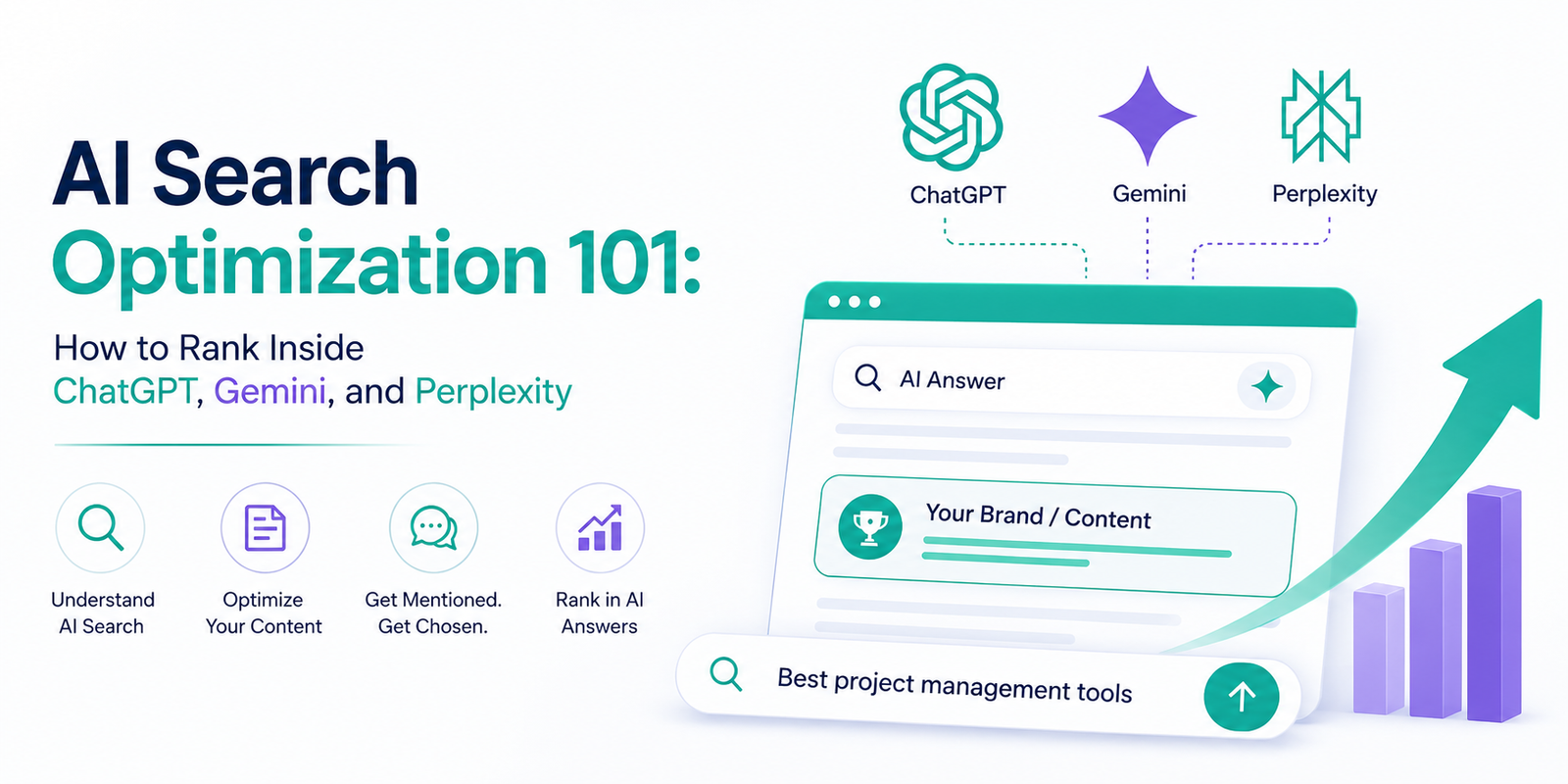
AI Search Optimization 101: How to Rank Inside ChatGPT, Gemini, and Perplexity
ChatGPT now has roughly 900 million weekly active users. That’s not a typo, and it’s not a niche audience of early adopters anymore it’s a population larger than the United States, the EU, and Canada combined, asking questions every single week instead of typing them into Google.
Add Gemini, Claude, Perplexity, and the AI Overviews sitting on top of Google itself, and you get a simple, uncomfortable picture: millions of people are now getting answers about products, services, and vendors without ever seeing a traditional search results page.
So here’s the question worth sitting with for a second: if your business isn’t being recommended by AI, how many customers are you missing right now, today, without even knowing it?
That’s not a rhetorical scare tactic. It’s a measurable, growing gap. And closing it is exactly what AI search optimization the practice of making your brand visible, citable, and recommendable inside AI-generated answers is designed to do. It’s quickly becoming one of the most important marketing disciplines of the decade, sitting right next to (and increasingly ahead of) traditional SEO.
This guide breaks down how AI search actually works, how it’s different from Google, and what you can do starting today to show up inside the answers your customers are already asking for.
Statistic: ChatGPT crossed 900 million weekly active users in early 2026 more than double the roughly 400 million it reported a year earlier. Meanwhile, Google’s own AI Mode surpassed 1 billion monthly users, and researchers have documented that traditional Google searches now end without a single click more often than not.
How Google Search Works vs. How AI Search Works
To optimize for AI search, you first need to understand that it isn’t just “SEO with a chatbot skin.” It’s a fundamentally different retrieval and ranking system.
How Google Search Works (the short version)
Traditional search follows a familiar path:
- Crawling – Googlebot discovers and downloads pages.
- Indexing – Content is parsed, categorized, and stored.
- Ranking – An algorithm scores pages against a query using hundreds of signals (links, relevance, page experience, freshness, and more).
- Serving – A ranked list of ten-ish blue links is returned, with the user choosing which one to click.
The core mechanic is: match a query to the best individual page, then let the human do the synthesis.
How AI Search Works
AI search engines like ChatGPT, Gemini, Perplexity, and Google’s own AI Overviews don’t return a list they return an answer. That answer is assembled through a very different pipeline:
- Query fan-out – A single question is silently broken into multiple related sub-queries so the model can research the topic from several angles, not just the literal words typed.
- Multi-source retrieval – Instead of pulling from one page, the system gathers snippets from many pages, forums, documentation sites, and databases simultaneously.
- Retrieval-Augmented Generation (RAG) – The model combines retrieved, real-time content with its own trained knowledge to generate a response, rather than relying purely on memorized facts.
- Source verification – Retrieved content is checked for consistency across multiple sources before being trusted enough to appear in the answer.
- Citation selection – The model decides which specific sources are authoritative and clear enough to cite or link, discarding the rest even if they were retrieved.
- Context understanding – The system interprets intent, prior conversation turns, and implied meaning, not just keywords.
- Entity recognition – Brands, people, products, and concepts are matched to structured knowledge about “what this thing is,” not just text strings.
- Semantic relevance – Meaning is matched even when exact keywords don’t appear, using embeddings rather than keyword matching.
- AI confidence scoring – The model weighs how certain it is in a claim before stating it, favoring content that reduces ambiguity and hallucination risk.
This is exactly why ranking #1 on Google does not guarantee visibility inside ChatGPT. Google’s ranking rewards the single best-optimized page for a query. AI search rewards the source that is easiest to verify, extract, and synthesize alongside several others. A page can dominate a SERP and still never get pulled into an AI-generated answer if it isn’t structured for extraction, isn’t corroborated elsewhere, or isn’t confidently attributable to a real entity.
Example: A SaaS company might rank #1 for “best project management software for agencies” on Google through years of backlink building. But if ChatGPT can’t clearly identify who the company is, what the product does, and find that claim corroborated across review sites, comparison articles, and its own structured markup, it may never be mentioned in the AI-generated answer to that same question while a smaller competitor with a clean entity profile and strong third-party mentions gets recommended instead.
Pro Tip: Don’t audit your visibility by Googling your brand name. Ask ChatGPT, Perplexity, and Gemini the actual questions your buyers ask “best [category] for [use case]” and see whether you show up at all.
What Is AI Search Optimization?
AI search optimization (sometimes shortened to “AI SEO”) is the practice of structuring your brand’s content, data, and digital footprint so that large language models and AI answer engines can find, understand, trust, and cite you when responding to relevant queries.
It sits at the intersection of three disciplines:
- AEO (Answer Engine Optimization) – optimizing content to be selected as a direct answer.
- GEO (Generative Engine Optimization) – optimizing for inclusion and citation inside generative, synthesized responses.
- Traditional technical SEO – the underlying infrastructure (site speed, crawlability, structured data) that both classic search and AI systems still depend on.
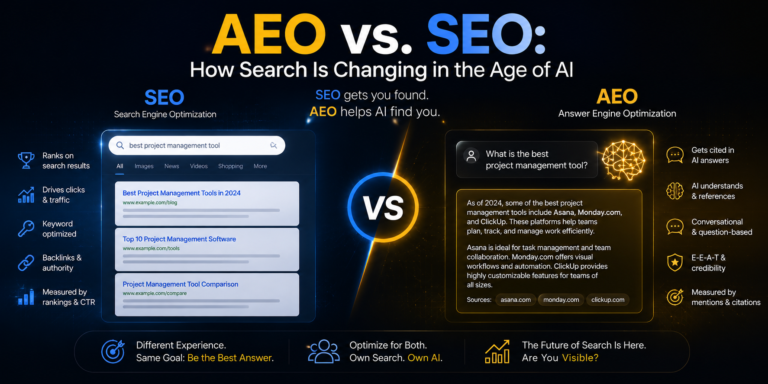
Where traditional SEO asks, “How do I rank #1?”, AI search optimization asks, “How do I become the source an AI trusts enough to mention by name?”
Why Traditional SEO Is No Longer Enough
Traditional SEO was built for a web where clicking through to a website was the entire point. That assumption is breaking down fast.
Research firm SparkToro’s 2026 analysis of Similarweb clickstream data found that a majority of U.S. Google searches now end without a click to any website at all, and that share climbs sharply higher when an AI Overview appears on the page. Separately, Gartner has forecast a significant decline in traditional search engine volume as more queries shift to AI chatbots and assistants.
That means three things for marketers:
- Rankings alone no longer guarantee traffic. A page can “rank” and still never get visited because the answer was already delivered on the results page.
- Being cited matters more than being clicked. A brand mention inside an AI answer builds trust and awareness even without a visit.
- Optimizing for extraction is now as important as optimizing for ranking. Content has to be written and formatted in a way that a language model can lift, verify, and attribute cleanly.
SEO isn’t dead. But SEO that only chases blue-link position ones is now optimizing for a shrinking share of how people actually find information.
How ChatGPT Finds Information
ChatGPT primarily draws on two sources when producing an answer: its trained knowledge, and when browsing or search is invoked live retrieval from the web, often layered with Bing-style indexing and OpenAI’s own crawling infrastructure. When it searches, it tends to favor pages that are:
- Clearly structured with descriptive headings
- Explicit about who the entity behind the content is
- Corroborated by other sources saying similar things
- Recently updated, especially for anything time-sensitive
- Free of noisy formatting that makes extraction harder
ChatGPT is also unusually sensitive to consensus if five independent, credible sources describe your product the same way, it’s far more likely to repeat that description confidently than if only your own homepage makes the claim.
How Gemini Retrieves Answers
Gemini has a structural advantage most competitors don’t: direct access to Google’s search index, Google’s Knowledge Graph, and real-time web data. This means Gemini’s answers are deeply informed by the same entity and structured-data signals that power Google’s Knowledge Panels and AI Overviews.
Practically, this means:
- Schema markup and structured data carry outsized weight for Gemini specifically.
- A strong presence in Google’s Knowledge Graph (Wikipedia, Wikidata, Google Business Profile, consistent NAP data) directly feeds Gemini’s understanding of who you are.
- Gemini tends to lean on Google’s existing authority signals domain trust, backlink profile, and historical ranking performance more than ChatGPT or Perplexity do.
Does Gemini use Google rankings? Not directly as a copy-paste of the SERP, but Gemini’s underlying retrieval is deeply intertwined with Google’s index and entity data, so strong traditional SEO fundamentals still meaningfully help your Gemini visibility in a way they don’t always help with ChatGPT or Perplexity.
How Perplexity Selects Sources
Perplexity has built its entire brand identity around transparent, numbered citations it typically shows users exactly which sources it pulled from for every claim. That makes it one of the more traceable places to study what “winning” AI visibility actually looks like.
Perplexity tends to favor:
- Pages with clear, quotable, standalone statements of fact
- Sources with strong topical authority in a specific niche (rather than broad generalist sites)
- Content that directly and concisely answers a question near the top of the page
- Reputable third-party sources publications, documentation, and reference sites over self-promotional brand content
How do I optimize for Perplexity? Focus on writing clear, extractable, single-idea statements early in your content, back them with credible external validation, and make sure your brand’s factual profile (what you do, who you serve, what makes you different) is consistent everywhere it appears online.
Expert Insight: The common thread across ChatGPT, Gemini, and Perplexity isn’t which model you optimize for it’s whether independent, corroborating sources exist across the web that all describe your brand consistently. AI models are consensus engines. One polished landing page saying you’re the best rarely moves the needle; ten independent sources agreeing on the same facts does.
The Difference Between SEO, AEO, GEO, and AI Search Optimization
These terms get used almost interchangeably, but they describe different layers of the same strategy.
| Discipline | Primary Goal | Optimized For | Core Tactics |
|---|---|---|---|
| SEO | Rank on search engine results pages | Google, Bing | Keywords, backlinks, technical SEO, page experience |
| AEO | Be selected as a direct answer | Featured snippets, voice assistants, AI Overviews | Concise Q&A formatting, structured data, direct answers |
| GEO | Be cited or referenced inside generated text | ChatGPT, Gemini, Perplexity, AI Overviews | Topical authority, entity clarity, corroborated facts, citations |
| AI Search Optimization | Overall visibility across the entire AI answer ecosystem | All of the above, combined | AEO + GEO + technical SEO + entity + trust signals |
Think of AI search optimization as the umbrella strategy, with AEO and GEO as its two most important tactical pillars.
How AI Search Ranking Factors Differ From Google
| Factor | Traditional Google SEO | AI Search Optimization |
|---|---|---|
| Primary unit ranked | Individual web page | Brand/entity, synthesized across many sources |
| Backlinks | Major ranking signal | Helpful, but secondary to consistent corroboration |
| Keywords | Exact and partial match matter heavily | Semantic meaning and intent matter more than exact phrasing |
| Content format | Long-form ranks well broadly | Scannable, structured, directly answerable content extracts better |
| Freshness | Matters for some query types | Matters heavily models favor recently verified information |
| Structured data | Helps rich results | Often essential for entity recognition and knowledge graph inclusion |
| Third-party mentions | Helps via link equity | Core trust signal consensus across sources drives citation |
| Success metric | Ranking position, click-through rate | Citation frequency, brand mention accuracy, share of AI answers |
Common Mistake
Common Mistake: Treating AI search optimization as “SEO plus a few FAQ pages.” Businesses that copy-paste their existing content strategy without addressing entity clarity, structured data, and third-party corroboration typically see little to no improvement in AI visibility, because the underlying trust and consensus signals AI models rely on were never built.
The Biggest Mistakes Businesses Make
- Only optimizing the homepage. AI models pull from your entire footprint documentation, review sites, forums, press not just your marketing pages.
- Ignoring structured data. Without schema markup, models have to guess at your entity, pricing, and offerings instead of parsing them directly.
- No original data or research. AI models gravitate toward sources with unique, citable statistics not recycled summaries of what everyone else already said.
- Inconsistent brand facts across the web. Conflicting descriptions of what your company does confuse entity recognition and reduce confidence scoring.
- No third-party validation. A brand that only talks about itself, on its own domain, rarely earns the “consensus” AI models look for.
- Treating this as a one-time project. AI search optimization is ongoing; models re-crawl, re-verify, and update their understanding continuously.
- Writing for keyword density instead of clarity. Keyword-stuffed content is often harder for models to extract cleanly than plainly written, well-structured prose.
10 Proven Ways to Improve AI Search Visibility
1. Build Topical Authority
Publish a cluster of interlinked content that comprehensively covers your core topic area, not just a single blog post. AI models are more likely to trust and cite a source that clearly “owns” a subject across dozens of pages than one with a single isolated article.
2. Implement Structured Data
Use Schema.org markup Organization, Product, FAQPage, Article, and Review schema to explicitly tell machines who you are, what you offer, and what others say about you. This is one of the clearest, most direct signals you can give both Google’s Knowledge Graph and AI retrieval systems.
3. Optimize FAQs Directly
Write FAQ sections using the exact phrasing your customers use, with concise, self-contained answers. Each Q&A pair should stand alone as a complete, extractable unit imagine a model lifting just that one paragraph with no other context.
4. Strengthen Entity Optimization
Make sure your brand exists as a clearly defined “entity” across Wikipedia/Wikidata (where eligible), Google Business Profile, Crunchbase, LinkedIn, and industry directories, with consistent naming, description, and details everywhere.
5. Earn Brand Mentions
Unlinked brand mentions on reputable third-party sites still contribute meaningfully to AI trust signals, even without a backlink. Models are reading mentions of your name in context, not just counting links.
6. Invest in Digital PR
Coverage in industry publications, podcasts, and roundups creates exactly the kind of independent corroboration AI models are looking for when deciding whether a claim about your brand is trustworthy enough to repeat.
7. Publish Original Research
Proprietary data, surveys, and benchmarks give AI models something unique to cite that can’t be found anywhere else and once cited, that data point tends to get repeated across many derivative sources, compounding your visibility.
8. Use Expert Authorship
Attribute content to named, credentialed experts with visible bios and credentials. This strengthens the “Expertise” and “Authoritativeness” components of E-E-A-T, which increasingly influence whether AI systems treat your content as a trustworthy source.
9. Build Trust Signals
Customer reviews, case studies, certifications, and transparent “About” and methodology pages all help AI systems (and humans) verify that your claims are backed by evidence, not just marketing copy.
10. Master AI-Friendly Formatting
Use clear H2/H3 hierarchy, short paragraphs, bullet points, and direct topic sentences. Answer the core question in the first sentence or two of each section before elaborating models frequently extract just the opening statement.
Additional reinforcing tactics:
- Internal linking – Connect related content so models (and crawlers) can map your topical authority across your site.
- Semantic SEO – Write around concepts and entities, not just exact-match keywords, so meaning is clear regardless of phrasing.
- Knowledge graph optimization – Keep your structured presence (Wikidata, Google Business Profile, industry databases) accurate and complete.
- Content freshness – Update statistics, screenshots, and claims regularly; AI systems weight recency heavily for anything that changes over time.
- Source credibility – Cite your own sources, link to primary data, and avoid unverifiable claims that could undermine model confidence in your content.
Actionable takeaway: Pick two or three of these ten levers you’re weakest on today, and fix those first trying to do all ten simultaneously usually means none of them get done well.
How to Measure Your AI Visibility
Traditional analytics weren’t built for this. Here’s what to track instead:
- Brand mention frequency – How often does ChatGPT, Gemini, or Perplexity mention your brand for relevant category queries?
- Citation share of voice – Out of all sources cited for a topic, what percentage are you, versus competitors?
- Accuracy of AI-generated descriptions – When AI tools describe your product, is the description correct and current?
- Referral traffic from AI platforms – Check analytics for referrals from chatgpt.com, perplexity.ai, and Gemini, which are increasingly trackable as distinct traffic sources.
- Share of answer – For your core commercial queries, are you named at all, and how prominently?
Statistic: Industry analyses have repeatedly found that a small handful of sources tend to capture the majority of citations for any given AI-generated answer meaning AI visibility, much like classic SEO, still rewards being in the top few trusted sources rather than merely “present somewhere on page one.”
Common AI Search Optimization Tools
Several categories of tools have emerged to help track and improve AI visibility:
- AI visibility trackers that monitor how often and how accurately your brand appears across ChatGPT, Gemini, Perplexity, and Copilot for target queries.
- Structured data validators (including Google’s own Rich Results Test) to confirm your schema markup is implemented correctly.
- Traditional SEO platforms like Ahrefs and Semrush, which have expanded into AI-citation and share-of-voice reporting.
- Log file and referral analyzers to identify and separate AI-crawler traffic (GPTBot, ClaudeBot, PerplexityBot, Google-Extended) from standard bot traffic.
- Content structuring and schema generators that help teams standardize FAQ, Article, and Organization markup at scale.
No single tool covers the whole picture yet most teams combine two or three to get a complete view of their AI footprint.
How AgentBuyable Helps Businesses Rank Inside AI
This is the part of AI search that trips most teams up: it touches technical SEO, content strategy, structured data, digital PR, and increasingly the commerce layer that lets AI agents actually transact on a customer’s behalf. Very few in-house teams are set up to do all of it well at once.
That’s the gap AgentBuyable was built to close. Rather than treating AI visibility as a bolt-on to existing SEO work, AgentBuyable approaches it as its own discipline, built around six connected services:
- AI Visibility Audits – A full diagnostic of how ChatGPT, Gemini, Perplexity, and Google AI Overviews currently describe (or fail to describe) your brand, including where competitors are winning the citation you should have.
- AI Search Optimization – Ongoing, hands-on optimization of your content, structure, and entity presence to increase citation frequency and accuracy across AI platforms.
- AEO Services – Structuring content specifically to be selected as a direct answer inside featured snippets, voice assistants, and AI Overviews.
- GEO Services – Building the topical authority, corroboration, and semantic clarity that generative engines need to cite you confidently inside synthesized answers.
- ACP/UCP Integration – Implementing emerging agentic commerce protocols (Agentic Commerce Protocol and Universal Commerce Protocol) so AI shopping agents can not only recommend your business but complete a transaction with it directly.
- AI Commerce Optimization – Preparing product data, pricing, and inventory feeds so autonomous AI agents can evaluate and transact with your business accurately, not just mention it.
The throughline across all six: AgentBuyable treats “being found by AI” and “being transactable by AI” as one connected problem, because the businesses winning in this next phase of search won’t just be recommended they’ll be ready when an AI agent tries to actually buy from them.
Future Trends in AI Search
A few directions are worth watching closely as this space matures:
- Agentic commerce is arriving fast. Protocols like ACP and UCP are emerging specifically so AI agents can browse, compare, and purchase on a user’s behalf meaning “AI visibility” will increasingly include whether an agent can complete a transaction with you, not just mention your name.
- Multimodal retrieval is expanding. AI systems are increasingly pulling from video, audio, and image content, not just text, widening what counts as an optimizable asset.
- Personalized AI answers will fragment “ranking” further. As models tailor responses to individual users’ history and preferences, a single, universal “rank” for a query will matter less than consistent presence across many contextual variations of that query.
- Verification and source-transparency will keep tightening. As AI providers face pressure over accuracy, expect continued emphasis on citable, verifiable, well-attributed content over vague marketing claims.
- Zero-click behavior will keep climbing. With Google’s own AI Mode and AI Overviews expanding rapidly, brands that only measure success by click-through traffic will increasingly be measuring the wrong thing.
Get Your Free AI Search Scorecard
Here’s the honest truth: most businesses have no idea what ChatGPT, Gemini, or Perplexity are currently saying about them or whether they’re being mentioned at all.
AgentBuyable’s AI Search Scorecard shows you exactly where you stand, including:
- Whether ChatGPT actually knows your brand and what it says when asked
- Whether Gemini recommends you for relevant category searches
- Whether Perplexity cites your site as a source
- Your overall AI visibility score compared to competitors
- The specific AI optimization gaps costing you visibility right now
If your business isn’t showing up in the conversations your customers are already having with AI, that’s a solvable problem but only once you know where the gaps are. Reach out to AgentBuyable today to claim your free AI Search Scorecard and find out exactly where you stand.
Frequently Asked Questions
What is AI Search Optimization?
AI search optimization is the practice of structuring your website, content, and brand data so AI systems like ChatGPT, Gemini, and Perplexity can find, understand, and confidently cite your business when responding to relevant user queries.
How is AI Search different from SEO?
Traditional SEO ranks individual web pages against a query and returns a list of links. AI search synthesizes information from many sources into a single generated answer, so success depends on being one of the trusted sources pulled into that synthesis not just ranking a page highly.
Can ChatGPT rank websites?
ChatGPT doesn’t rank websites the way Google does. When it uses live search, it retrieves and evaluates multiple sources, then decides which are credible and clear enough to cite or summarize in its answer a process driven by corroboration and clarity rather than a traditional ranking algorithm.
Does Gemini use Google rankings?
Gemini doesn’t simply copy Google’s SERP order, but its retrieval is closely tied to Google’s search index and Knowledge Graph, so traditional SEO signals like structured data, domain authority, and entity clarity carry more direct weight for Gemini than for most other AI assistants.
How do I optimize for Perplexity?
Focus on clear, standalone, quotable statements near the top of your content, strong topical authority in a specific niche, and consistent factual corroboration across multiple credible third-party sources, since Perplexity is built around transparent, traceable citations.
What is GEO?
GEO (Generative Engine Optimization) is the practice of optimizing content specifically to be referenced or cited inside AI-generated text responses, focusing on topical authority, entity clarity, and corroborated facts rather than traditional keyword ranking.
What is AEO?
AEO (Answer Engine Optimization) is the practice of structuring content to be selected as a direct answer inside featured snippets, voice assistants, and AI Overviews typically through concise, self-contained Q&A formatting and structured data.
What are AI SEO services?
AI SEO services (also called AI search optimization services) are professional services that audit and improve how a business appears across AI-powered search tools, combining technical SEO, structured data, content strategy, and digital PR to increase AI citation and visibility.
What is an LLM optimization agency?
An LLM optimization agency specializes in helping businesses become recognizable, trustworthy, and citable to large language models combining entity optimization, structured data, and content strategy so LLM-powered tools like ChatGPT and Gemini accurately represent and recommend the business.